Written by Phillip George · Last updated: September 9, 2026
What to do before you go out, and after you come in
This is a working checklist: what to put on skin, what to put on clothes, where to look when you get home, and what actually kills ticks in the laundry. The prevention guide has more on each product class. Yard sprays, tick tubes and deer devices are on the tick control page, because killing ticks on a drag cloth is not the same as preventing infection in people.
No single habit is enough on its own. A 2022 review of United States epidemiologic studies found that tick checks, repellents and protective clothing had mixed results across studies, and that no one measure was consistently effective (Schwartz et al., Zoonoses and Public Health, 2022). Use the layers together. The steps below are the ones with the clearest published support, plus the CDC and EPA instructions that match them.
Before you go out: skin repellent is not clothing treatment
Keep two products in different jobs. Skin gets an EPA-registered tick repellent. Clothes, shoes and gear can get permethrin. Do not put clothing permethrin on skin.
- On skin: pick a product the EPA has registered for ticks. Actives currently listed for ticks include DEET, picaridin, IR3535, oil of lemon eucalyptus (OLE), para-menthane-diol (PMD) and 2-undecanone. Use the EPA repellent finder and follow the label for how often to reapply. OLE and PMD are not for children under three years.
- On clothes: 0.5% permethrin, applied to fabric and allowed to dry. CDC treats this as clothing and gear, not a lotion (CDC, Preventing tick bites).
Factory-impregnated work clothes have the best field numbers. Among outdoor workers in Rhode Island and southern Massachusetts, long-lasting permethrin clothing reduced reported tick bites by 65% in year one and 50% in year two, for a two-year protective effect of 58% (Mitchell et al., Journal of Medical Entomology, 2020). An earlier North Carolina trial in forestry and wildlife staff found 82% protective effectiveness in year one and 34% in year two, which was no longer statistically significant (Vaughn et al., American Journal of Preventive Medicine, 2014). Both trials were in people who already used other prevention. A pair of treated hiking pants and shorts on the weekend is not the same setup, so expect a smaller effect.
Light-coloured long pants tucked into socks still help you see ticks on fabric. They do not replace permethrin or a skin repellent. Details on each skin active, including age limits, live on the prevention guide.
While you are outside
- Walk the centre of the trail. Unfed nymphs quest on leaf litter and the grass edge, not on bare dirt in the middle of a path. The habitats page explains why the lawn-woods border is the high-risk strip at home.
- Do not sit on logs or the forest floor if you can avoid it.
- Reapply skin repellent as the label says after swimming or heavy sweat. Permethrin on fabric is not a reason to skip the skin product on uncovered arms and the neck.
When you come back in: dryer, shower, then a real tick check
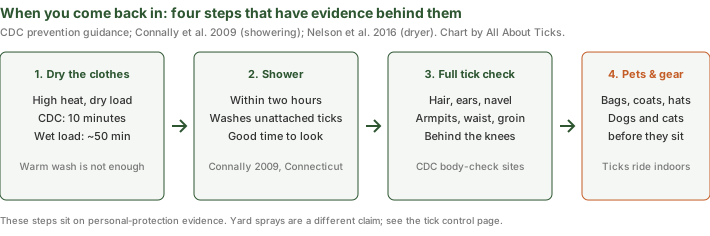
Do these in order. Clothes first, so ticks do not walk off a heap of pants onto the sofa. Then shower. Then look, including the sites people skip.
1. Tumble-dry dry clothes on high heat
Heat and dryness kill ticks. A wash often does not. In residential machines, all blacklegged ticks survived cold washes, and most survived warm washes. Water had to reach about 54°C (130°F) to kill them in the washer, which many home heaters never deliver. Dry clothes placed in a dryer with dry towels on high heat killed adults and nymphs in minutes: all ticks were dead at 4 minutes, and the authors treated 6 minutes as the safe mark. Wet clothes that had just been washed needed about 50 minutes on high heat because the load stays cooler until the water is gone (Nelson et al., Ticks and Tick-borne Diseases, 2016).
CDC translates that into a household rule: tumble dry on high heat for 10 minutes to kill ticks on dry clothing, and allow more time if the clothes are damp (CDC). If the clothes are muddy, dry them first on high heat, then wash. A warm wash followed by hanging the clothes to dry is the sequence that lets ticks survive.
2. Shower within two hours
In a Connecticut case-control study, bathing within two hours of time in the yard was associated with lower odds of Lyme disease (odds ratio 0.42; 95% CI 0.23 to 0.78). Checking for ticks within 36 hours of yard time was also protective (odds ratio 0.55; 95% CI 0.32 to 0.94) (Connally et al., Vector-Borne and Zoonotic Diseases, 2009). CDC now recommends showering soon after being outdoors for that reason: it can wash off ticks that have not attached, and it is a convenient moment to look. It will not remove a tick that is already locked on. Pull those with fine-tipped tweezers; see tick removal.
3. Check the sites ticks actually pick
CDC lists the places to look after time outdoors: under the arms, in and around the ears, inside the belly button, behind the knees, between the legs, around the waist, and in and around the hair. Nymphs are poppy-seed size. Run fingers, not just a glance in a dark bathroom. Check children at those same sites. A mirror or a second person is the only practical way to see the scalp and back.
4. Gear and pets before they sit down
Ticks ride in on packs, coats, picnic blankets and dogs. Check pets before they lie on the carpet. Veterinary tick-prevention products belong on the pets page; this checklist does not substitute for a veterinarian. Hang outdoor gear away from beds until you have looked it over.
Yard sprays and medical care
Yard sprays are a different question. A randomised trial of a spring bifenthrin application cut questing ticks by about 63% and did not reduce human tick-borne disease. That comparison is on tick control. Landscaping (mowing, a dry barrier at the woods edge, playgrounds away from the brush line) is still worth doing because it changes where people stand, but it is not a proven substitute for the personal steps above.
It is also not medical advice. If you develop a rash, fever or flu-like illness after a bite, contact a healthcare provider. Saving the tick in a sealed bag can help an identification service; a pathogen test on the tick is not the same as a diagnosis in you.
Questions about this checklist
Product details and age limits are in the prevention guide. For what a pest-control quote actually buys, see tick control.