Written by Phillip George · Last updated: September 6, 2026
When is tick season in Pennsylvania?
Pennsylvania has no tick-free month. The Department of Environmental Protection runs its blacklegged tick surveillance in two seasons that between them cover the whole year: nymphs from late April through late July, and adults from October through April. Early summer is the dangerous stretch. In 2023, 56.4% of the state's Lyme disease cases were reported in June, July and August, which is exactly when the poppy-seed-sized nymphs are questing (PA Department of Health, Lyme and Other Tickborne Diseases 2023 Report, PDF).
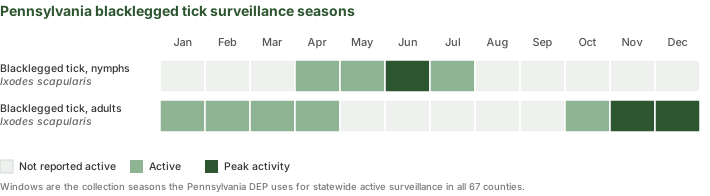
The Pennsylvania tick calendar, month by month
- January to March: adult blacklegged ticks quest on any day above freezing. Winter bites are uncommon but not rare, and the DEP adult collection season runs straight through.
- April: the overlap month. Adults are finishing, nymphs start appearing in the last week. Spring bites are usually attributed to adult blacklegged and adult American dog ticks.
- May to July: nymphal season, and the period that generates most human disease. The DEP samples this window deliberately because nymphs drive transmission.
- August: nymph numbers fall away. Lyme case reports stay high because diagnosis lags exposure by weeks.
- September: the quietest month of the year, between the nymphal and adult peaks.
- October to December: the adult season opens. Pennsylvania emergency departments see a rise in tick-bite complaints in the fall, consistent with adult blacklegged ticks emerging, and these are the ticks most likely to be noticed and reported because they are large enough to see.
Which ticks bite people in Pennsylvania
The DEP concentrates on the blacklegged tick because it drives nearly all of the state's tick-borne disease, but four other species turn up often enough in collections to matter. Pennsylvanians call the blacklegged tick a deer tick, and the two names mean the same animal.
| Species | Local name | Active months | Pathogens tested for in PA | Where you meet it |
|---|---|---|---|---|
| Ixodes scapularis Blacklegged tick |
Deer tick | Nymphs late April to late July; adults October to April | Borrelia burgdorferi (Lyme), Anaplasma phagocytophilum, Babesia microti, Borrelia miyamotoi, Borrelia mayonii, deer tick virus (Powassan lineage II) | Deciduous woodland, leaf litter, field edges. Infected ticks confirmed in all 67 counties |
| Dermacentor variabilis American dog tick |
Wood tick | Spring and early summer | Spotted fever group rickettsiae | Grassy and open ground, trail edges, pasture |
| Amblyomma americanum Lone star tick |
Lone star | Spring through summer | Ehrlichia species; associated with alpha-gal syndrome | Expanding in southern counties; woodland and brush |
| Haemaphysalis longicornis Asian longhorned tick |
Longhorned tick | Spring through autumn | Not established as a human disease vector in PA; a serious livestock pest | Pasture and grassland; reproduces without mating, so numbers build fast |
| Amblyomma maculatum Gulf Coast tick |
Gulf Coast tick | Summer | Rickettsia parkeri | Uncommon; collected in DEP surveys in grassland habitat |
How infected Pennsylvania ticks actually are
The DEP has run active surveillance since autumn 2018, collecting at least 50 blacklegged ticks per county from two or more sites each season and testing them individually. In the 2023 nymphal season it collected 3,053 nymphs from all 67 counties and found a statewide Borrelia burgdorferi infection rate of 29.2%, consistent with previous years. The Anaplasma phagocytophilum rate was 9.6%, nearly double the 5.4% recorded in 2022, which the Department of Health links to a doubling of human anaplasmosis cases.
In the 2023 to 2024 adult season, October through April, the DEP collected 4,629 adults from every county and found Borrelia miyamotoi in 1.4%, Anaplasma phagocytophilum in 9.6%, Babesia microti in 4.8% and Powassan virus in 0.4%. Adults are the more dangerous stage on infection odds alone, because an adult has fed twice rather than once and so carries roughly twice the likelihood of harbouring a pathogen.
Roughly 29% of nymphs carrying Lyme bacteria sounds alarming, and the practical reading is more reassuring than it first appears: transmission still takes sustained attachment, so a tick found and removed the same day is a much smaller problem than the infection rate suggests.
How many cases Pennsylvania reports
Pennsylvania reported 16,671 Lyme disease cases in 2023, an incidence of 128.6 per 100,000 people, and ranked sixth in the nation on cases per population. Every one of the 67 counties reported at least one case, from 11 in Adams County to 1,485 in Philadelphia County. County incidence varied enormously, from 9.3 per 100,000 in Berks County to 3,485.7 per 100,000 in Cameron County — rural counties consistently outrank urban ones.
That 16,671 is a 98.2% increase on the 8,413 reported in 2022, and the jump needs a caveat rather than a headline. In 2022 the CDC and the Council of State and Territorial Epidemiologists changed the national case definition so that high-incidence states like Pennsylvania count positive laboratory reports alone, without public health staff investigating each one. The Department of Health says plainly that an increase in case count was expected as a result. Comparing 2023 with 2022 measures a counting change as much as a change in disease.
Beyond Lyme, Pennsylvania recorded 1,292 anaplasmosis cases, 224 babesiosis cases, 63 ehrlichiosis cases and 12 spotted fever rickettsiosis cases in 2023, plus 13 cases of hard tick relapsing fever between 2020 and 2023. Babesiosis and hard tick relapsing fever are not reportable conditions in Pennsylvania, so those counts rest on voluntary laboratory reporting and are near-certainly undercounts.
Free tick testing for Pennsylvania residents
Pennsylvania has one of the best public tick resources in the country. The Pennsylvania Tick Research Lab tests ticks free of charge for Pennsylvania residents, with results typically in about three business days. You mail the tick in; the lab identifies the species and tests it for pathogens.
Two limits are worth understanding before you rely on it. The Department of Health does not itself offer tick identification or testing, so the Tick Research Lab is the route. More importantly, a tick test tells you what the tick was carrying, not whether you were infected. A positive result is useful information for a clinician and a reason to watch yourself closely; it is not a diagnosis, and a negative result does not rule out a bite from a different tick you never found.
Where risk concentrates in Pennsylvania
Because infected blacklegged ticks have been confirmed in every county, there is no part of Pennsylvania where the answer is "no risk here". The county incidence figures point at the pattern that matters: the highest rates sit in the rural, heavily wooded north and centre of the state, including the northern tier and the Poconos, while the dense south-east reports large absolute case numbers spread across a much bigger population. Lyme incidence is highest in two age groups, children aged 5 to 9 and adults aged 55 to 84, which tracks who spends unstructured time in the yard and the woods.
Habitat is a better predictor than the county map. Deciduous woodland with deep leaf litter holds moisture and is prime; the transition zone where a mown lawn meets the treeline is where most residential encounters happen. Open, sunny, dry ground is poor tick habitat. Our guide to tick habitats covers the ecology in more detail, and yard-level tick control covers what actually reduces risk on a property.
Found a tick in Pennsylvania? Do this
- Remove it promptly with fine-tipped tweezers — follow our tick removal guide. Save the tick in a bag or container.
- Get it tested for free: Pennsylvania residents can submit the tick to the PA Tick Research Lab (ticklab.org) at East Stroudsburg University, which tests for Lyme and other pathogens at no cost (results typically within about 72 business hours).
- Record the date and location and monitor for a rash or flu-like symptoms for several weeks.
- Contact a healthcare provider if symptoms develop — a positive tick test is useful context but does not replace medical evaluation.
Cite this section
All About Ticks. Ticks in Pennsylvania. Updated 2026-09-06. Based on the Pennsylvania Department of Health Lyme and Other Tickborne Diseases 2023 Report, the PA Department of Environmental Protection Tick Surveillance and Testing Program, the PA Tick Research Lab, and CDC tick guidance.
Official Pennsylvania resources
- PA Department of Health — Lyme disease
- PA Department of Health — Tick diseases
- PA Tick Research Lab (ESU) — free tick testing for PA residents
- CDC — What to do after a tick bite
Questions Pennsylvanians ask
Where to go from here
If a tick is attached, start with the removal guide. Neighbouring states: New York and New Jersey.