Written by Phillip George · Last updated: August 30, 2026
When is tick season in Ontario?
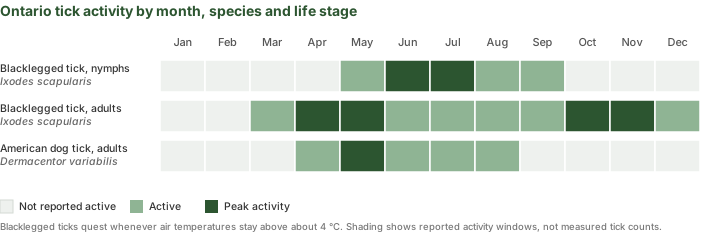
Blacklegged ticks in Ontario are active from roughly April to November, and the highest-risk stretch is June and July. That is when nymphs quest — poppy-seed-sized, easily missed, and responsible for most human infections. Adults take over in spring and again in autumn, and will quest on any day air temperatures stay above about 4 °C, which increasingly includes mild spells in March and late November.
Ontario's other common human-biting tick has a much narrower window. Adult American dog ticks were submitted from Ontario between late April and early August, with a sharp peak in late May and a slow decline through the summer (Nichol et al., Medical and Veterinary Entomology, 2025). So a large mottled tick in May is almost certainly a dog tick, and a tiny dark one in July is almost certainly a blacklegged nymph.
Where the established risk areas actually are
Ontario is unusual in having a genuinely good public tool for this, and it is worth using rather than reading a generic description. Public Health Ontario's Vector-Borne Disease Tool carries an interactive map of blacklegged tick established risk areas, redrawn annually, and it shows how the boundaries have moved since 2015.
As of the 2025 map, most risk areas sit in southern Ontario along the north shores of Lake Erie, Lake Ontario and the St. Lawrence River, with additional areas inside the Northwestern and Thunder Bay health unit boundaries. That year's revision added thirteen newly identified areas across six public health units. The 2026 map, published in May 2026, reflects the 2025 field season and added a further eight.
The map is built from real fieldwork rather than modelling: tick dragging data from active surveillance are reported to Public Health Ontario annually by the National Microbiology Laboratory at the Public Health Agency of Canada. Since May 2026 the tool also carries a Ticks tab showing passive submissions from healthcare providers and the public, drawn from Public Health Ontario's laboratory system and supplemented with eTick data.
One caveat that Public Health Ontario states itself and that matters more than the map's edges: blacklegged ticks feed on and are carried by migratory birds, so it is possible to encounter an infected blacklegged tick almost anywhere in Ontario where the habitat suits — wooded or brushy ground. Being outside a shaded polygon is not a reason to skip a tick check.
Toronto and the Lake Ontario shoreline
Toronto sits on the north shore of Lake Ontario, which is exactly the corridor Public Health Ontario names as carrying most of the province's established risk areas. The city's practical exposure is concentrated in the habitat that supports ticks: the ravine system, wooded lakeshore parks, and conservation land at the edges of the built-up area. Mown turf in the middle of a park is poor tick habitat; the leafy, shaded ravine path beside it is good habitat.
Rather than assume a classification for a specific neighbourhood, check the address against the risk area layer in the Vector-Borne Disease Tool, which is updated annually and reports at health unit level. For a weekend trip, the eastern Ontario and St. Lawrence corridor and the Lake Erie north shore both carry more established risk than the city itself.
Ontario reports more Lyme disease than any other province
Ontario recorded 2,369 Lyme disease cases in 2024, about 41% of Canada's national total of 5,809 and a 27% increase over its 2023 figure of 1,859. Ontario, Nova Scotia and Quebec together accounted for 96% of all Canadian cases (Public Health Agency of Canada, Tick-borne disease surveillance in Canada). Ontario has the largest absolute count; Nova Scotia has by far the highest rate per head.
For current-season numbers, the Vector-Borne Disease Tool publishes weekly and year-to-date case counts at both provincial and public health unit level, for Lyme disease, anaplasmosis, babesiosis, Powassan virus infection and West Nile virus illness. That is a better source than any static figure, including this one.
All four of Ontario's tick-borne diseases of public health significance come from the same species. The blacklegged tick is the primary vector for Lyme disease, anaplasmosis, babesiosis and Powassan virus infection, which is why identifying the tick matters so much here.
Which ticks bite people in Ontario
| Species | Common name | Active months | Pathogens in Ontario | Where you meet it |
|---|---|---|---|---|
| Ixodes scapularis | Blacklegged tick, deer tick | April to November; nymphs peak June and July, adults spring and autumn | Borrelia burgdorferi (Lyme), Anaplasma phagocytophilum, Babesia microti, Powassan virus | Wooded and brushy ground and its edges, leaf litter; risk areas concentrated along the lower Great Lakes and St. Lawrence |
| Dermacentor variabilis | American dog tick | Late April to early August, peak late May | None of Ontario's four tick-borne diseases of public health significance | Meadows, pasture, trail edges; submissions concentrate in eastern Ontario |
Other species turn up occasionally on Ontario hosts, usually carried in by migratory birds, without being considered established. If you are not sure what you found, photograph it rather than guessing — the difference between the two rows above decides whether Lyme disease is a consideration at all.
Getting an Ontario tick identified
eTick covers Ontario. Upload clear photographs and a trained reviewer returns a species identification at no cost, usually within a couple of days. Since 2026, eTick submissions also feed the passive surveillance layer in Public Health Ontario's Vector-Borne Disease Tool, so a photograph you submit contributes to the provincial record as well as answering your own question.
What identification does not do is tell you whether the tick was infected. Ontario's public health laboratory testing is directed at surveillance rather than individual clinical decisions, and a species identification changes what you watch for rather than diagnosing anything.
Preventive antibiotics after an Ontario tick bite
The clinical standard applied in Ontario is the 2020 guideline from the Infectious Diseases Society of America, the American Academy of Neurology and the American College of Rheumatology, which is deliberately restrictive. A single dose of oral doxycycline is recommended within 72 hours of tick removal, but only when a bite is high-risk on all three counts: an identified Ixodes vector species, in a highly endemic area, attached for 36 hours or longer. Bites that cannot be classified with confidence get watchful waiting instead (IDSA/AAN/ACR Lyme disease guideline, 2020).
This is where the risk area map becomes clinically relevant rather than merely interesting: the "highly endemic area" criterion is what the established risk area designation is used to assess. Contact your provider or your local public health unit about a specific bite.
Common questions about Ontario ticks
After a bite in Ontario
- Remove the tick promptly with fine-tipped tweezers, pulling straight out. Skip matches, nail polish and petroleum jelly — our tick removal guide explains why.
- Photograph it before discarding and submit to eTick. Dog tick or blacklegged tick is the decisive question.
- Note the date, the estimated attachment time and the location, including whether it falls in an established risk area.
- Watch for a spreading rash or flu-like illness over the following weeks. What tick-borne illness looks like in people covers the timelines for all four Ontario infections.
Ontario's season is long enough that prevention habits beat seasonal vigilance. Our practical prevention checklist covers permethrin-treated clothing and the routine for coming indoors; the full tick prevention guide goes further on repellents and yard changes, and tick control covers what the evidence says about treating a property.
Cite this section
All About Ticks. Tick Season in Ontario. Updated 2026-08-30. Based on Public Health Ontario Vector-Borne Disease Tool documentation, Public Health Agency of Canada surveillance data for 2024, and Nichol et al. (2025).
Official Ontario resources
- Public Health Ontario — Vector-Borne Disease Tool, with the interactive blacklegged tick risk area map and weekly case counts
- Public Health Ontario — Lyme disease
- Ontario.ca — Tick-borne diseases
- eTick.ca — free photo-based tick identification
- Public Health Agency of Canada — Tick-borne disease surveillance annual report