Written by Phillip George · Last updated: September 9, 2026
When is tick season in Wisconsin?
Blacklegged tick nymphs peak in June, and that is the stretch that produces most human infections. Adults are active in spring and again in autumn. Nymphs matter most because they are about the size of a poppy seed and are harder to find than adults. Wisconsin has no month in which the honest answer is zero risk, but early summer is when a missed bite does the most damage.
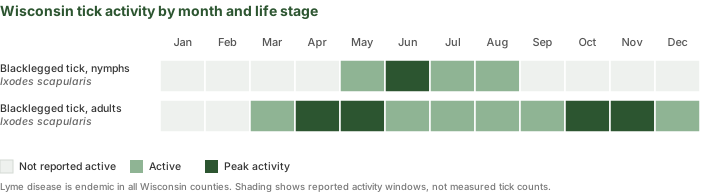
The Wisconsin tick calendar, month by month
- January and February: quiet. Adult blacklegged ticks are inactive in typical winter weather.
- March: adults start appearing on warm days.
- April and May: adult spring peak. Nymphs become active in May.
- June: nymphal peak, and the highest-risk month for a bite you never notice.
- July and August: nymphs remain active. Case reports stay high because diagnosis lags exposure.
- September to December: adult season returns, with a fall peak in October and November.
Which ticks bite people in Wisconsin
Wisconsinites say deer tick for the blacklegged tick, and wood tick for the American dog tick. The deer tick is the one that drives nearly all of the state's tick-borne disease. Dog ticks are the large, ornate ticks of grasslands and prairie edges.
| Species | Local name | Active months | Pathogens associated in WI | Where you meet it |
|---|---|---|---|---|
| Ixodes scapularis Blacklegged tick |
Deer tick | Nymphs May to August, peak June; adults spring and autumn | Lyme disease (Borrelia burgdorferi and, rarely, B. mayonii), anaplasmosis, babesiosis, Powassan virus | Statewide; historically densest in northern and western woods |
| Dermacentor variabilis American dog tick |
Wood tick | Spring and early summer | Spotted fever group rickettsiae | Grassland, prairie and trail edges, especially central and southern Wisconsin |
| Amblyomma americanum Lone star tick |
Lone star | Spring through summer when found | Not established as a routine human-disease vector in Wisconsin | Occasionally collected; range is shifting north |
How many cases Wisconsin reports
The Wisconsin Department of Health Services recorded 6,469 Lyme disease cases in 2024, the highest on record, against an average of about 4,600 a year from 2019 to 2023. Reported incidence has quadrupled over the past 20 years (Wisconsin DHS — Lyme disease data).
CDC national surveillance recorded 6,283 Lyme disease cases in Wisconsin in 2023 (CDC Lyme disease surveillance data; NNDSS annual tables, 2023). Wisconsin is a high-incidence jurisdiction, so those CDC figures are counted as probable cases under the 2022 national case definition. DHS is explicit that the 2022 case-definition change increased counts because fewer criteria are required for a report to be counted. Comparing 2023 or 2024 with 2021 is not a clean measure of disease change.
Most Wisconsin Lyme disease is caused by Borrelia burgdorferi. A second species, Borrelia mayonii, also causes Lyme disease. It was first detected in the Midwest in 2013, and DHS reports 10 cases in Wisconsin residents from 2013 to 2024. That is rare beside the thousands of B. burgdorferi reports, but it is why Wisconsin is one of the few states where clinicians and laboratories watch for a second Lyme bacterium (Wisconsin DHS Lyme data, B. mayonii section; Pritt et al., 2016, Lancet Infectious Diseases).
Every county, not only the north woods
DHS treats Lyme disease as endemic in every Wisconsin county, so any Wisconsin resident is considered exposed. Deer ticks are present in all counties. The disease and the tick that carries it spread from the north-western part of the state to nearly all areas over the past 35 years. The highest historical densities remain in the northern and western woods and the Driftless Area, but the southern and southeastern counties are no longer a free pass (Wisconsin Environmental Public Health Tracking — Lyme disease; DHS — About Lyme disease).
Named landscape still helps more than a county colour. Leaf litter under deciduous woods, the brush along a trail, and the strip where a mown lawn meets the treeline are where most bites happen. Open, sunny, dry ground is poor tick habitat. Our guide to tick habitats covers the ecology, and yard-level tick control covers what the evidence actually shows about reducing risk on a property.
Tick identification in Wisconsin
Wisconsin does not run a statewide free tick-testing service comparable to Pennsylvania's Tick Research Lab. DHS guidance is to remove the tick, save it if you wish, and contact a healthcare provider if symptoms develop. Commercial labs will test a tick for a fee; a result still tells you what that tick carried, not whether you were infected. The identification guide and the interactive identifier will get you to genus and, in most cases, to species.
Found a tick in Wisconsin? Do this
- Remove it promptly with fine-tipped tweezers. Follow the tick removal guide. Save the tick in a bag or container if you want it identified later.
- Identify the species well enough to tell a deer tick from a wood tick. That distinction changes which diseases are on the table.
- Record the date and location and watch for a rash or flu-like symptoms for several weeks. Anaplasmosis and babesiosis matter here, not only Lyme.
- Contact a healthcare provider if symptoms develop. Wisconsin clinicians are used to the full range of tick-borne illness, including the rare B. mayonii cases.
Cite this section
All About Ticks. Ticks in Wisconsin. Updated 2026-09-09. Based on Wisconsin Department of Health Services Lyme disease data and about pages, Wisconsin Environmental Public Health Tracking, and CDC Lyme surveillance tables for 2023.
Official Wisconsin resources
- Wisconsin DHS — Illnesses spread by ticks
- Wisconsin DHS — About Lyme disease
- Wisconsin DHS — Lyme disease data
- Wisconsin EPHT — Lyme disease
- CDC — What to do after a tick bite
Common questions
Where to go from here
If a tick is attached, start with the removal guide. The national picture is on the USA hub.