Written by Phillip George · Last updated: August 30, 2026
When is tick season in Québec?
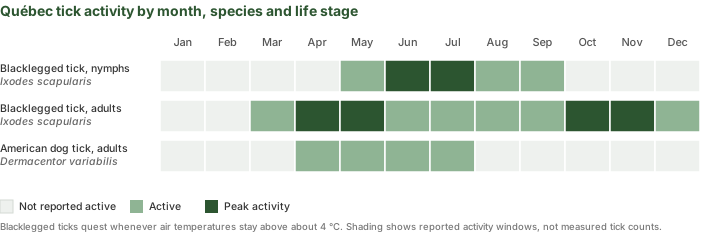
Blacklegged ticks in Québec are active from roughly April to November, and the two weeks you most need to worry about fall in June and July. That is when the nymphs quest — poppy-seed-sized, easy to miss, and responsible for most human infections. Adults have a second period of activity in autumn, which catches people out because the trails feel safe by October.
The temperature threshold matters more than the calendar. Ixodes scapularis quests whenever air temperatures stay above about 4 °C, so a mild March or a warm November extends the season at both ends. INSPQ is explicit that Lyme disease acquisition is possible in every region of Québec, because migrating birds drop infected ticks well outside the established zones (INSPQ, Maladies transmises par les tiques).
The regional split is enormous
Québec's Lyme disease is not spread evenly across the province; it is concentrated in a handful of southern territories to a degree that surprises most people. Of the 728 Lyme disease cases acquired in Québec in 2024, the Estrie alone reported 406 — about 56% of the provincial total, at an incidence of 61.4 per 100,000 person-years and an age-standardised rate seven times the provincial figure.
| Region | Lyme cases | Incidence per 100,000 person-years |
|---|---|---|
| Estrie | 406 | 61.4 |
| Montérégie | 196 | 12.0 |
| Laurentides | 31 | 2.7 |
| Mauricie et Centre-du-Québec | 29 | 3.7 |
| Montréal | 29 | 1.5 |
| Lanaudière | 19 | 2.2 |
| Outaouais | 7 | 0.7 |
| Laval | 5 | 0.8 |
| Chaudière-Appalaches | 2 | 0.2 |
| Capitale-Nationale | 1 | not reported |
| Québec total | 728 | 8.2 |
Zoom in one level further and the concentration is sharper still: 79% of the Estrie's cases came from just two local service network territories, La Pommeraie and Haute-Yamaska, a pattern that has held for several years. The same two territories accounted for 86% of Québec's anaplasmosis cases, of which the province recorded 37 in 2024.
The endemic-municipality list is the tool to actually use
Rather than reproducing a risk map, INSPQ publishes something more precise: a municipality-by-municipality list of the Lyme disease endemic zone, and it is the document your doctor will consult. A municipality enters the zone if it meets any one of three surveillance criteria — at least 3 locally acquired human cases in the past five years; at least 23 human-origin I. scapularis submissions through passive surveillance in five years; or three life stages, or at least six specimens of the same stage, collected in one year of active surveillance with at least one nymph or adult positive for Borrelia burgdorferi. Any municipality within 20 km of one that qualifies is included as well.
That 20 km buffer was added in 2024 and it changed the map dramatically: the endemic list jumped from 117 municipalities in 2023 to 461 in 2024. Most of the increase reflects the new criteria rather than a sudden tick explosion, which is worth knowing before you read too much into the year-over-year change. All Montérégie municipalities are now included. Northern regions — Côte-Nord, Nord-du-Québec, Terres-cries-de-la-Baie-James and Nunavik — have no established blacklegged tick populations.
Check your own address against the INSPQ endemic municipality list and risk map, and see where specimens have actually been submitted from on the eTick public map.
Québec City and the Capitale-Nationale
Québec City sits outside the heart of the risk zone, and the numbers show it: the Capitale-Nationale recorded a single locally acquired Lyme disease case in 2024, against 406 in the Estrie. Neighbouring Chaudière-Appalaches, across the river, recorded two. If you live in or visit Québec City, the honest answer is that ticks are present but established, infected populations are sparse compared with the Eastern Townships.
Two caveats keep this from being a clean "no". Migrating birds drop infected ticks anywhere in the province, so an individual bite near Québec City can still carry risk. And the endemic zone has been moving north and east year on year, so a low count in 2024 is not a permanent state. Treat wooded trails around the city the same way you would anywhere else in southern Québec: check when you get home.
Montréal and Laval
Montréal reported 29 locally acquired cases in 2024, an incidence of 1.5 per 100,000, and Laval reported 5. These are real but modest numbers for a metropolitan area of that size, and they sit far below the Montérégie immediately to the south. The practical implication for Montrealers is that the higher-risk exposure is usually a weekend trip rather than a walk at home — the Montérégie and Estrie are an hour or two away and carry eight to forty times the incidence. Wooded parks on the island are worth a tick check; a hike near Granby or Bromont warrants the full routine.
Which ticks bite people in Québec
| Species | Common name | Active months | Pathogens in Québec | Where you meet it |
|---|---|---|---|---|
| Ixodes scapularis | Blacklegged tick, deer tick, tique à pattes noires | April to November; nymphs peak June and July, adults spring and autumn | Borrelia burgdorferi (Lyme disease), Anaplasma phagocytophilum (anaplasmosis), Babesia microti (babesiosis) | Deciduous woodland and its edges, leaf litter, brushy trail margins across southern Québec |
| Dermacentor variabilis | American dog tick, tique américaine du chien | Sporadic spring and summer submissions | Not a meaningful Lyme vector in Québec | Open grassy ground, pasture and trail edges |
The size difference is the practical tell. An I. scapularis nymph is about the size of a poppy seed and reddish-brown with a darker shield; an adult American dog tick is several times larger and carries pale mottling on the back. If you are unsure, photograph it rather than guessing.
eTick is run from Québec
Québec has an advantage other provinces do not: eTick, the national photo-based tick identification platform, is operated from Bishop's University in Sherbrooke — in the middle of the Estrie, the province's highest-incidence region. Upload photographs of the tick and a trained reviewer returns a species identification, usually within a couple of days, at no cost.
eTick identifies the species; it does not test for pathogens. Québec's separate passive acarological surveillance runs through the Laboratoire de santé publique du Québec, using ticks submitted voluntarily by physicians, and that stream is one of the three data sources feeding the endemic-municipality determination. INSPQ also publishes an illustrated identification guide if you want to try first.
Post-exposure prophylaxis in Québec
Québec's endemic-municipality list does double duty: it also defines the geographic areas where post-exposure prophylaxis may be recommended after a tick bite, when the other conditions are met. This is why the list is worth checking by address rather than by region — two neighbouring towns can fall on different sides of it.
The underlying clinical standard is the same one used across North America. The 2020 IDSA, AAN and ACR guideline recommends a single dose of oral doxycycline within 72 hours of tick removal, but only for a bite that is high-risk on all three counts: an identified Ixodes vector species, in a highly endemic area, attached for 36 hours or longer. Bites that cannot be classified with confidence get watchful waiting instead (IDSA/AAN/ACR Lyme disease guideline, 2020). Call Info-Santé 811 or your own clinician to work through the criteria for a specific bite.
Common questions about Québec ticks
After a bite in Québec
- Remove the tick with fine-tipped tweezers, pulling straight out without twisting. Our tick removal guide covers technique and the methods that make transmission more likely.
- Photograph it and submit to eTick, or check it against the INSPQ identification guide.
- Write down the date and the municipality. The municipality determines whether prophylaxis is on the table.
- Watch for a spreading rash or flu-like illness over the following weeks — what tick-borne illness looks like in people sets out the timelines.
If you spend time in the Estrie or Montérégie regularly, the return on prevention is higher than anywhere else in Canada. Our practical prevention checklist covers permethrin-treated clothing and the post-outing routine; the full tick prevention guide goes deeper on repellent choice.
Cite this section
All About Ticks. Tick Season in Québec. Updated 2026-08-30. Based on INSPQ annual tick-borne disease surveillance results for 2024 and Public Health Agency of Canada surveillance data.
Official Québec resources
- INSPQ — Annual tick-borne disease surveillance results, 2024, the source of the regional case table above
- INSPQ — Tick-borne diseases, including the endemic municipality list and risk map
- INSPQ — Identification guide for ticks found in Québec
- Québec.ca — Lyme disease
- eTick.ca — free photo identification, run from Bishop's University in Sherbrooke
- Public Health Agency of Canada — Tick-borne disease surveillance annual report