Written by Phillip George · Last updated: August 30, 2026
When is woodtick season in Manitoba?
Woodtick season in Manitoba runs from late April to early July, with the peak at the end of May. Numbers then fall away fast: a six-province study of adult American dog ticks (Dermacentor variabilis) recorded Manitoba specimens from the end of April to the beginning of July, peaking at the end of May, with a rapid decline in the first days of July (Nichol et al., Medical and Veterinary Entomology, 2025).
Woodtick season ending is not the same as tick season ending, and this is where most Manitobans get caught out. The province places blacklegged tick (Ixodes scapularis) exposure across April to November, with nymphs active in late spring and early summer and adults active in spring and again in autumn. Blacklegged ticks keep questing until the first permanent snowfall or once air temperatures sit consistently below about 4 °C (Province of Manitoba, About Blacklegged Ticks). July through September is quiet for woodticks and busy for the tick that carries Lyme disease.
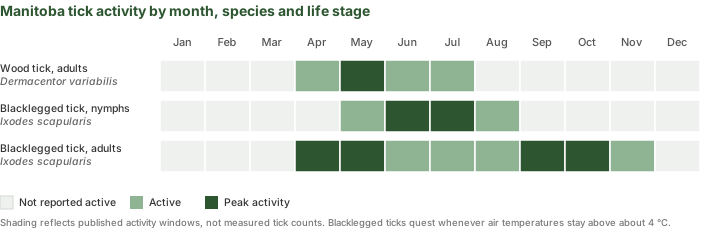
The Manitoba tick calendar, month by month
- April: woodticks appear as the snow goes, usually in the last week of the month. Blacklegged adults resume questing on the same warm days.
- May: the heaviest woodtick month of the year, with the submission peak at month's end. Blacklegged adults are still out.
- June: woodticks are still common but declining. Blacklegged nymphs — poppy-seed-sized and easy to miss — become the main concern.
- Early July: woodtick numbers collapse. Adults that have not fed shelter under ground debris and generally will not quest again until the following spring (Western College of Veterinary Medicine, University of Saskatchewan).
- Mid-July to August: effectively no woodticks. Blacklegged nymph activity carries through.
- September to November: the autumn blacklegged adult period. This is the leg of the season people forget, because the familiar spring woodtick has been gone for months.
Two ticks, two very different risks
Manitoba has many tick species, but two bite people often enough to matter, and only one of them transmits disease here. Manitoba Health is unusually direct about it: of the several species in the province, only Ixodes scapularis spreads tick-borne disease to humans, and the more common woodtick is not an effective vector.
| Species | Local name | Active months | Pathogens it transmits in Manitoba | Where you meet it |
|---|---|---|---|---|
| Dermacentor variabilis American dog tick |
Woodtick | Late April to early July; peak late May | None of Manitoba's three reportable tick-borne diseases | Grassy and open ground, pasture, trail edges; abundant across southern Manitoba |
| Ixodes scapularis Blacklegged tick |
Deer tick | April to November; nymphs late spring and early summer, adults spring and autumn | Borrelia burgdorferi (Lyme disease), Anaplasma phagocytophilum (anaplasmosis), Babesia microti (babesiosis) | Deciduous woodland and its edges, riparian corridors, farmstead shelter belts |
Telling them apart is straightforward once you know the tell. American dog ticks carry white or silvery markings on the back; blacklegged ticks do not. Unfed adult female blacklegged ticks run 3 to 5 mm and are bright red and dark brown; males are smaller and uniformly dark brown. Adult blacklegged ticks are noticeably smaller than woodticks.
Where blacklegged tick risk concentrates
The provincial line to remember is the 53rd parallel. Blacklegged ticks are now established through much of southern Manitoba south of it, wherever suitable habitat exists; north of it, encounters are mostly ticks dropped by migrating birds. The expansion has been rapid and is documented: active surveillance ran from 2006 to 2018, and in 2006 only a single risk area was identified, in the extreme southeast corner of the province.
Habitat matters more than the map, though. Blacklegged ticks need moist, shaded ground, so deciduous woodland with deep leaf litter is prime. Two features make Manitoba unusual: rivers and streams act as wildlife corridors that carry tick populations out into prairie that would otherwise be too dry, and shelter belts around farmsteads create isolated pockets of suitable habitat. Open grassland, cultivated fields, bogs, wetlands and genuinely dry ground are poor habitat and carry much lower risk (Province of Manitoba, Tick-Borne Disease Surveillance).
For the national picture, the Public Health Agency of Canada maintains a tick-borne disease surveillance dashboard with provincial case data, and eTick's public map shows where identified specimens have actually been submitted from.
Winnipeg and the Red River corridor
Winnipeg sits well south of the 53rd parallel, so the city is inside the established blacklegged tick zone rather than outside it. The practical risk in the city is concentrated in exactly the habitat the province describes: treed river corridors and their edges. The Red and Assiniboine river banks are wooded, humid and full of the small mammals and deer that keep tick populations going, which is the combination the province flags as suitable habitat expanding into otherwise unsuitable prairie.
Woodticks behave differently in and around the city. They favour open, grassy ground, so ditch banks, unmown boulevards, ball diamonds and pasture edges are where they collect in May. The best local field data on the species comes from a two-year study of immature D. variabilis at Birds Hill Park, just northeast of Winnipeg: larval infestation of small mammals peaked between the last week of May and mid-June, nymphal infestation peaked in July, and the tick appeared to run a two-year life cycle in Manitoba rather than the faster cycle seen further south (Burachynsky and Galloway, Canadian Journal of Zoology, 1985). Treat a mown trail through tall grass as woodtick ground and a shaded riverbank path as blacklegged tick ground.
How many cases Manitoba actually reports
Manitoba reported 84 Lyme disease cases in 2024, up from 58 in 2023 — a 45% increase in one year. The longer trend is the more useful number: 5 cases in 2009, 51 in 2016, and 84 in 2024. Manitoba's 2024 count is a small share of Canada's 5,809 cases, 96% of which came from Ontario, Nova Scotia and Quebec, but the provincial trajectory is clearly upward (Public Health Agency of Canada, Tick-borne disease surveillance in Canada, annual report covering 2024).
Three tick-borne diseases are reportable in Manitoba: Lyme disease, anaplasmosis and babesiosis. All three come from the blacklegged tick. Transmission takes time — the province notes that blacklegged ticks often do not begin feeding for the first 24 hours after attaching, and that transmission of these three agents typically needs a minimum attachment period of at least 24 hours. That is the entire argument for a same-day tick check.
Getting a Manitoba tick identified
Manitoba routes public tick submissions through eTick, a photo-based platform where you upload images and receive a species identification from a trained reviewer, usually within a couple of days. It is free, and it works from a phone. Passive tick surveillance in Manitoba has been running since 1995, so submissions feed a genuinely long provincial record.
Two limits are worth stating plainly. eTick identifies the species; it does not test the tick for pathogens, and the province is explicit that the blacklegged tick surveillance programme is not intended to inform clinical diagnosis in people or pets. Identification still changes what you do next, because a woodtick means you can stop worrying about Lyme disease and a blacklegged tick means you should not.
What Manitoba tells clinicians about preventive antibiotics
Manitoba publishes specific criteria for considering a preventive dose of antibiotic after a high-risk bite, and they differ enough from generic advice to be worth knowing before you call. The province advises clinicians to consider preventive treatment when all four of the following hold: the tick can be reliably identified as a blacklegged tick; it was attached for a minimum of 36 hours or is engorged; it was picked up in southern Manitoba south of the 53rd parallel or another known Lyme disease risk area; and the patient has no known allergy to doxycycline (Province of Manitoba, Lyme disease).
Manitoba also runs a referral-based provincial service, the Tick Collaborative Care Service, for diagnosing and managing possible late Lyme disease and other emerging tick-borne infections. Access is by referral from a healthcare provider. For general questions after a bite, Health Links–Info Santé is reachable at 204-788-8200 in Winnipeg or 1-888-315-9257 elsewhere in the province.
Questions Manitobans ask
After a bite in Manitoba
- Remove the tick promptly with fine-tipped tweezers, pulling straight out. Our tick removal guide covers the technique and the folk methods that make things worse.
- Photograph it before you discard it and submit the photo to eTick. A woodtick and a blacklegged tick lead to different decisions.
- Note the date and the place. If the bite happened south of the 53rd parallel, that fact is one of Manitoba's four criteria for preventive treatment.
- Watch for a spreading rash or flu-like illness over the following weeks, and read what tick-borne illness looks like in people so you know what you are watching for.
Getting ahead of next season is more effective than reacting to a bite. Our practical prevention checklist covers permethrin-treated clothing and the post-outing routine, and the fuller tick prevention guide goes into repellent choice and yard changes.
Cite this section
All About Ticks. Woodtick Season in Manitoba. Updated 2026-08-30. Based on Province of Manitoba tick-borne disease resources, Public Health Agency of Canada surveillance data for 2024, and Nichol et al. (2025).
Official Manitoba resources
- Province of Manitoba — Lyme disease, including the preventive-treatment criteria
- Province of Manitoba — About blacklegged ticks, the source of the April to November activity window
- Province of Manitoba — Tick-borne disease surveillance and annual reports
- Province of Manitoba — Prevention of tick-borne diseases
- eTick.ca — free photo-based tick identification
- Public Health Agency of Canada — Tick-borne disease surveillance annual report