Written by Phillip George · Last updated: September 9, 2026
When is tick season in New Jersey?
New Jersey has no genuinely tick-free month. The Rutgers Center for Vector Biology reports blacklegged tick nymphs active from April through November, with peak abundance from May to July. Adults are active from October to April and will quest on any winter day above freezing. The invasive Asian longhorned tick is active from March through October. May through July is the stretch that produces most human disease, because that is when the poppy-seed-sized nymphs are out (Rutgers NJ Ticks 4 Science — blacklegged tick).
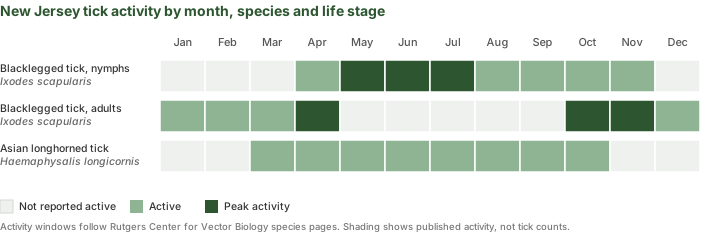
The New Jersey tick calendar, month by month
- January to March: adult blacklegged ticks quest on any day above freezing. The Asian longhorned tick starts appearing in March.
- April: nymphs begin. Adults are finishing their spring peak. This is the overlap month.
- May to July: nymphal peak, and the period behind most Lyme, anaplasmosis and babesiosis cases. Rutgers lists peak nymph abundance as May to July.
- August to November: nymph numbers fall but they remain active through November. Larvae of the blacklegged tick peak from August to October.
- October to December: adult season opens. October and November are the fall adult peak. Adults continue through winter whenever it thaws.
Which ticks bite people in New Jersey
Four human-biting species are established in New Jersey. Residents usually say deer tick for the blacklegged tick, and wood tick for the American dog tick. The mix is not the same in Hunterdon as it is in the Pinelands.
| Species | Local name | Active months | Pathogens associated in NJ | Where you meet it |
|---|---|---|---|---|
| Ixodes scapularis Blacklegged tick |
Deer tick | Nymphs April to November, peak May to July; adults October to April | Lyme disease, anaplasmosis, babesiosis, Borrelia miyamotoi disease, Powassan virus | Statewide: leaf litter, woodland edges, the lawn-woods boundary |
| Amblyomma americanum Lone star tick |
Lone star | Spring through summer | Ehrlichia species; associated with STARI and alpha-gal syndrome | Central and southern counties, the Pinelands and the shore |
| Dermacentor variabilis American dog tick |
Wood tick | Spring and early summer | Spotted fever group rickettsiae | Grassy and open ground statewide |
| Haemaphysalis longicornis Asian longhorned tick |
Longhorned tick | March through October | Not established as a human disease vector in New Jersey; a serious livestock and dog pest | Tall grass, meadows, pastures, farms, and the edge of a sports field beside woods |
How many cases New Jersey reports
CDC national surveillance recorded 7,224 Lyme disease cases in New Jersey in 2023 (CDC Lyme disease surveillance data; NNDSS annual tables, 2023). New Jersey is a high-incidence jurisdiction, so those reports are counted as probable cases under the 2022 national case definition, which relies on laboratory evidence without a case-by-case clinical investigation. Comparing 2023 with earlier years measures a counting change as much as a change in disease.
CDC also estimates that roughly 476,000 people in the United States are diagnosed and treated for Lyme disease each year, far above the 89,000-plus cases reported through surveillance in 2023. Reported counts are a lower bound, not a census of infections (CDC Lyme disease surveillance and data).
The same blacklegged tick also spreads anaplasmosis and babesiosis. Lone star ticks add ehrlichiosis and are the species most often linked to alpha-gal syndrome. For symptoms and timelines, see what tick-borne illness looks like in people.
The Asian longhorned tick started here
New Jersey is where the invasive Asian longhorned tick was first reported in the United States: on a sheep in Hunterdon County in 2017, by members of the Rutgers Center for Vector Biology. The species is parthenogenetic, so an unmated female can produce a clone generation, and numbers can build fast on cattle, horses and dogs. Rutgers reports large infestations in Bergen, Mercer, Middlesex, Monmouth, Somerset and Union counties. It favours tall grasses, meadows, pastures, farms and ecotones such as a soccer field beside woodland. It rarely feeds on people, though heavy autumn larval infestations can cause itchy bites mistaken for chiggers (Rutgers — Asian longhorned tick).
Where risk concentrates in New Jersey
Blacklegged ticks are established from the northwest hills to the Pinelands, so there is no county where the honest answer is "no Lyme risk here". Named places still help. The wooded northwestern counties — Hunterdon, Warren, Sussex and Morris — are the classic deer-tick landscape of deciduous woods and leaf litter. Central and southern New Jersey, including the Pine Barrens and the shore, is where lone star ticks become the aggressive human-biters people notice. Asian longhorned tick infestations have been heaviest in a band of counties around the Raritan and lower Hudson, not only in Hunterdon where the first sheep was found.
Habitat still beats the county map. The strip where a mown lawn meets the treeline is where most residential encounters happen. Open, sunny, dry ground is poor tick habitat. Our guide to tick habitats covers the ecology, and yard-level tick control covers what the evidence actually shows about reducing risk on a property.
Getting a New Jersey tick identified
The Rutgers Center for Vector Biology runs NJ Ticks 4 Science, which publishes species pages, active months and county records for the ticks found in the state. The New Jersey Department of Environmental Protection also publishes an annotated list of the hard ticks of New Jersey. Some county mosquito control commissions accept ticks for identification. New Jersey does not run a statewide free pathogen-testing service comparable to Pennsylvania's Tick Research Lab.
A tick test, if you pay a commercial lab, tells you what that tick carried. It does not tell you whether you were infected. A negative result also does not rule out a bite from a different tick you never found.
Found a tick in New Jersey? Do this
- Remove it promptly with fine-tipped tweezers. Follow the tick removal guide. Save the tick in a bag or container.
- Identify the species with the identification guide or the interactive identifier, then check Rutgers' county records if you want to know whether that species is established where you found it.
- Record the date and location and watch for a rash or flu-like symptoms for several weeks.
- Contact a healthcare provider if symptoms develop. A tick identification is useful context, not a diagnosis.
Cite this section
All About Ticks. Ticks in New Jersey. Updated 2026-09-09. Based on Rutgers Center for Vector Biology NJ Ticks 4 Science species pages, the New Jersey Department of Health Lyme disease page, and CDC Lyme surveillance tables for 2023.
Official New Jersey resources
- New Jersey Department of Health — Lyme disease
- Rutgers NJ Ticks 4 Science
- Rutgers Center for Vector Biology
- CDC — What to do after a tick bite
Common questions
Where to go from here
If a tick is attached, start with the removal guide. Neighbouring states: Pennsylvania and New York.