Written by Phillip George · Last updated: September 9, 2026
Ticks in the United States: the national picture
Which tick you meet, and what it can carry, depends on the region. CDC recorded 89,468 Lyme disease cases in 2023 through national surveillance, and estimates that roughly 476,000 people are diagnosed and treated each year. Those two numbers are not a contradiction. Surveillance undercounts, and the larger figure includes people treated on clinical suspicion who may not have Lyme disease (CDC Lyme disease surveillance and data).
This hub is a national overview plus a comparison of the five states with full guides below. For a county map, use CDC's maps rather than a copy on this page. The official range maps are the ones that stay current.
Four tick regions, not one national season
- Northeast and Upper Midwest. The blacklegged tick, the deer tick of local speech, drives Lyme disease, anaplasmosis, babesiosis and Powassan. This band, from Maine and the Hudson Valley through Pennsylvania to Wisconsin and Minnesota, accounts for most reported US Lyme cases. Nymphs peak in late spring and early summer; adults peak in autumn and again in spring.
- Southeast and South-Central. The lone star tick dominates, and is an aggressive human-biter linked to ehrlichiosis, STARI and alpha-gal syndrome. The American dog tick spreads Rocky Mountain spotted fever in parts of this region.
- Pacific Coast. The western blacklegged tick (Ixodes pacificus) carries Lyme at lower infection rates than the northeastern deer tick.
- Rocky Mountain West. The Rocky Mountain wood tick can cause tick paralysis, Colorado tick fever and spotted fever.
Two ranges are also shifting. The lone star tick has been moving north. The invasive Asian longhorned tick was first found in the United States in Hunterdon County, New Jersey, in 2017 (Rutgers Center for Vector Biology; CDC — Where ticks live).
Reported Lyme cases in the states we cover
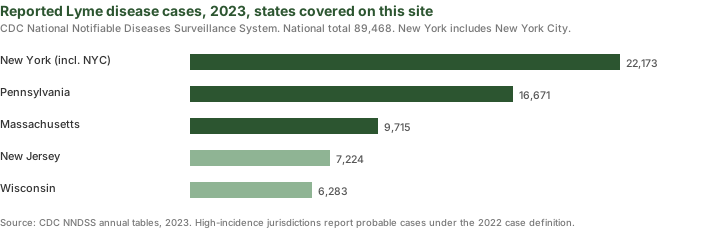
CDC's 2023 state table is the figure to cite for national comparison. High-incidence jurisdictions, including all five of these states, report probable cases under the 2022 case definition, which counts laboratory evidence without a case-by-case clinical investigation. Year-to-year jumps partly reflect that counting rule.
| State | Dominant human-biting ticks | Peak nymph months | Reported Lyme, 2023 | Where to submit a tick |
|---|---|---|---|---|
| New York | Blacklegged tick; lone star and Asian longhorned ticks in the south-east | June and July | 22,173 including New York City (NNDSS also publishes 18,861 excluding NYC and 3,312 for NYC) | No statewide free pathogen test; NYSDOH publishes tick risk scores and regional surveillance |
| Pennsylvania | Blacklegged tick statewide; dog tick, lone star, Asian longhorned, Gulf Coast tick in collections | Late April through late July | 16,671 | PA Tick Research Lab — free for residents |
| Massachusetts | Blacklegged tick; dog tick; lone star expanding on the Cape and islands | June and July | 9,715 | TickReport in Amherst, fee-based; DPH does not test ticks |
| New Jersey | Blacklegged tick; lone star in the south; Asian longhorned tick first found here in 2017 | May to July | 7,224 | Rutgers NJ Ticks 4 Science for identification and county records |
| Wisconsin | Blacklegged tick statewide; American dog tick in grassland | June | 6,283 | No statewide free test; DHS treats Lyme as endemic in every county |
These five states are not the whole US tick story. They are the states with full guides here. For Maine, Minnesota, Virginia or anywhere else, start with CDC's maps, then use the same questions: which species, which months, and where to get a tick identified.
What the numbers do not mean
Reported cases are assigned to county of residence, not county of exposure. A Long Island resident infected in the Hudson Valley counts as Long Island. Case definitions changed in 2022, so a doubling of reports is not automatically a doubling of infections. And CDC's 476,000 estimate is diagnoses and treatments, not confirmed infections. A hub page that treats its own table as a ranking of "worst states" would be misleading. Pennsylvania's incidence is high in rural counties and lower in the south-east even though Philadelphia reports a large absolute count. Wisconsin's 2024 state total of 6,469 is higher than its 2023 CDC figure of 6,283 because the two systems close their files on different dates and Wisconsin publishes a later year.
For current range, use the official maps:
Choose your state
Each state page answers when tick season runs, which species bite people, how many cases that state reports, where to get a tick identified, and which counties or corridors carry the most risk.
New York
Highest 2023 case count of the five, including New York City. Nymphs peak in June and July; Long Island and the lower Hudson Valley drive metropolitan risk.
Ticks in New YorkPennsylvania
Infected blacklegged ticks confirmed in all 67 counties. Free tick testing for residents through the PA Tick Research Lab.
Ticks in PennsylvaniaNew Jersey
Where the Asian longhorned tick was first found in the United States. Lone star ticks dominate the Pinelands and the shore.
Ticks in New JerseyMassachusetts
Cape Cod, Martha's Vineyard and Nantucket sit beside high babesiosis and anaplasmosis counts. TickReport in Amherst tests ticks for a fee.
Ticks in MassachusettsWisconsin
Lyme is endemic in every county. One of the few states with documented Borrelia mayonii infections alongside ordinary Lyme.
Ticks in WisconsinCite this section
All About Ticks. Ticks in the USA (by state). Updated 2026-09-09. Based on CDC Lyme disease surveillance data and NNDSS annual tables for 2023, CDC Where ticks live, and the state pages linked above.
Common questions
Where to go from here
If a tick is attached, start with the removal guide. For clothing, repellents and tick checks, use the prevention checklist. Canada's species and surveillance are different: start at the Canada hub.