Written by Phillip George · Last updated: September 6, 2026
When is tick season in New York?
New York's nymph season runs May through September, and June and July are the months that matter most. The State Department of Health surveys blacklegged tick nymphs across that window, and pairs it with a spring and autumn adult season. Adults quest on any winter day above freezing, so there is no month with zero risk (NYSDOH Tick-Borne Disease Report, 2025 edition covering 2024, PDF).
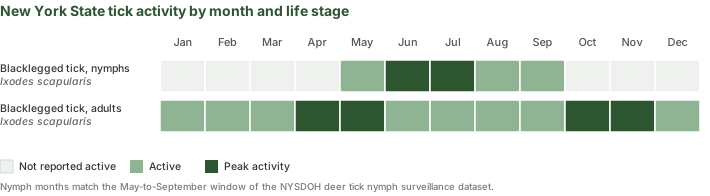
The New York tick calendar, month by month
- January to March: adult blacklegged ticks are out whenever the ground is not frozen. Low but real risk, and the stage large enough that most people notice it.
- April: adult activity peaks as the woods green up. Nymphs have not started yet.
- May: the state's nymph surveillance season opens. Both stages overlap, which makes this the month risk climbs fastest.
- June and July: peak nymph activity and the period that generates most human infection. Nymphs are about the size of a poppy seed and are routinely missed.
- August and September: nymph numbers taper but surveillance continues through September. Lone star ticks remain active downstate.
- October to December: the autumn adult peak. Deer movement during the rut spreads ticks, and hunters and late-season hikers are the exposed groups.
Which part of New York State has the most ticks?
Between 2020 and 2024 the highest average blacklegged tick nymph density was in the Metropolitan Area region, which covers New York City, Long Island and the lower Hudson Valley. That surprises people who assume tick risk rises as you go further from the city. Borrelia burgdorferi, the Lyme agent, is the leading pathogen found in nymphs in every region of the state, while Babesia microti is distinctly more prevalent in the Metropolitan Area than elsewhere.
In 2024 the state sampled 263 locations across 56 of its 62 counties, dragging public recreational areas and testing nymphs and adults separately. Powassan virus, also called deer tick virus, was detected that year in adult tick pools in the Metropolitan Area and Capital District regions. Lyme disease cases were reported in all 57 counties outside New York City.
The department publishes a Tick Risk Score map that scores the chance of encountering an infected blacklegged tick by region from 0 to 5, with separate scores for nymphs and adults. It is the most useful single tool for a New Yorker planning a season, with one caveat the department states itself: the density and pathogen measurements behind each score are taken at single points in time at a handful of locations per region, so a regional score can hide a great deal of local variation. Underlying nymph density and pathogen datasets are published through the Health Data NY open data portal.
Long Island and the lone star tick
Long Island is where New York's second tick story is unfolding. The lone star tick (Amblyomma americanum) is an aggressive human-biter, and unlike the blacklegged tick its larvae and nymphs will actively pursue a host. It does not transmit Lyme disease, but it is associated with ehrlichiosis, with the illness known as STARI, and with alpha-gal syndrome, a delayed allergy to red meat triggered by a tick bite. Long Island is also where the state's first human Bourbon virus infection was documented in 2026, which we cover in the tick news log.
The invasive Asian longhorned tick (Haemaphysalis longicornis) was first collected in New York State on 2 June 2017, during an active surveillance study of parks and schoolyards. It reproduces without mating, so a single female can found a population, and infestations build to remarkable densities. Its established significance in New York is to livestock and pets rather than to human disease.
Which ticks bite people in New York
| Species | Local name | Active months | Pathogens it can transmit | Where you meet it |
|---|---|---|---|---|
| Ixodes scapularis Blacklegged tick |
Deer tick | Nymphs May to September; adults spring and autumn | Lyme disease, anaplasmosis, babesiosis, hard tick relapsing fever, Powassan virus disease | Statewide. Highest average nymph density in the Metropolitan Area region |
| Amblyomma americanum Lone star tick |
Lone star | Spring through early autumn | Ehrlichia species, STARI; associated with alpha-gal syndrome | Long Island and the lower Hudson, spreading north |
| Dermacentor variabilis American dog tick |
Wood tick | Spring and early summer | Spotted fever group rickettsiae, uncommonly | Grassy verges, trail edges, open ground statewide |
| Haemaphysalis longicornis Asian longhorned tick |
Longhorned tick | Spring through autumn | Not established as a human disease vector in New York; a livestock concern | First collected in the state on 2 June 2017; downstate pasture and parkland |
Telling the first two apart changes what you watch for. An adult female lone star tick carries a single bright white or silver spot in the middle of her back; a blacklegged tick has no marking at all and is noticeably smaller. Our tick identifier tool narrows the options by region and markings.
How many cases New York reports
New York State recorded 18,704 confirmed or probable Lyme disease cases in 2024, excluding New York City, which reports separately. Incidence outside the city rose from 37.2 to 164.8 cases per 100,000 residents between 2020 and 2024.
That near-fivefold rise needs its caveat stated alongside it, and the department states it plainly: the national surveillance case definition changed in 2022 so that cases are classified on positive laboratory results alone, without requiring clinical evidence. NYSDOH says directly that this change contributed to the marked increases in its own charts. Real expansion is happening, but the size of the jump between 2021 and 2023 is substantially an artefact of counting, not a measure of how much sicker New Yorkers became.
Where risk concentrates in New York
Habitat predicts encounters better than any regional map. Blacklegged ticks need moist, shaded ground with deep leaf litter, so mature deciduous woodland and the shaded edge where a lawn meets the treeline are the highest-exposure spots. The Hudson Valley, the Catskills and the wooded suburbs of Westchester and Putnam combine that habitat with dense deer and white-footed mouse populations. Open, sunny, mown ground carries much lower risk, which is why the boundary between the two is where most residential bites happen. Our tick habitats guide covers the ecology, and yard-level control covers what genuinely reduces risk at home.
Found a tick in New York? Do this
- Remove it promptly with fine-tipped tweezers — follow our tick removal guide.
- Identify it using our tick identification guide — telling a blacklegged tick from a lone star tick changes what you watch for.
- Record the date and location and monitor for a rash or flu-like symptoms for several weeks.
- Contact a healthcare provider if symptoms develop, and ask about post-exposure options after a bite in a high-risk area.
Cite this section
All About Ticks. Ticks in New York. Updated 2026-09-06. Based on the New York State Department of Health Tick-Borne Disease Report (2025 edition, covering 2024), the NYSDOH Tick Risk Score programme, and CDC tick guidance.
Official New York resources
- New York State Department of Health — Lyme disease
- NYSDOH — Tick Risk Score by region (nymph and adult)
- NYSDOH — Tick-Borne Disease Report, 2025 edition (PDF)
- Health Data NY — nymph deer tick density, 2008 onward
- CDC — Ticks (species, regions, prevention)
- CDC — What to do after a tick bite
Questions New Yorkers ask
Where to go from here
With a tick attached, start with the removal guide. Neighbouring states: Pennsylvania, New Jersey and Massachusetts.