Written by Phillip George · Last updated: September 9, 2026
Killing ticks is not the same as preventing disease
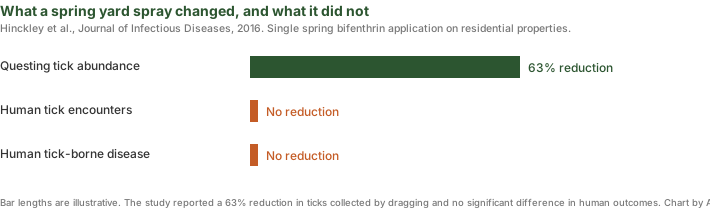
Most tick-control products are sold on tick counts. Published trials separate two outcomes: fewer ticks on a drag cloth, and fewer infections in people. Those outcomes often come apart. A randomised trial of a single spring bifenthrin spray on residential properties reduced questing ticks by about 63% and did not reduce human tick encounters or tick-borne disease (Hinckley et al., Journal of Infectious Diseases, 2016).
This page is educational, not an instruction to apply any pesticide at any rate. Products used against ticks in the United States must be registered by the EPA; labels, not this page, govern legal use.
| Intervention | Ticks | People | Evidence |
|---|---|---|---|
| Broadcast or barrier acaricide | Often down | No reduction in the Hinckley trial | Strong for ticks; weak for human disease |
| Tick tubes and rodent bait boxes | Sometimes down | No reduction in human cases in The Tick Project; pets did better | Moderate, mixed |
| Deer fencing | Down inside large exclosures | Protective in a case-control study of fencing as a household feature | Moderate |
| Deer population reduction | Down where density is cut hard | Mixed; not a dooryard project | Moderate, community-scale |
| Leaf-litter removal and sunlit barriers | Down in treated plots | Broader landscaping was not protective in Connally 2009 | Moderate for ticks; weak for people |
| 4-poster devices | Down in area-wide programmes | Not a residential product | Moderate, community-scale |
| Treating pets | Does not clear the yard | Protects the animal; Tick Project saw fewer pet infections with bait boxes | Strong for the pet, not a human-disease strategy |
Broadcast acaricides and barrier sprays
A barrier treatment is a strip of pesticide along the lawn-woods edge, where most residential ticks sit. A broadcast treatment covers a wider area. Synthetic pyrethroids such as bifenthrin are the usual active ingredients on residential labels. Laboratory and plot studies often show high tick mortality. The Hinckley trial is the study that asked the human question, and the human question came back negative.
Environmental trade-offs are real. Broadcast pyrethroids kill arthropods that are not ticks, including pollinators and aquatic invertebrates when runoff carries them off the lawn. EPA registration means a product can be sold for labelled uses; it is not a finding that the use will prevent Lyme disease in a family. CDC's prevention pages describe landscaping and personal protection as the core of residential risk reduction, with pesticides as an option rather than a guarantee (CDC — Preventing tick bites).
Tick tubes and rodent bait boxes
Tick tubes are cardboard tubes stuffed with permethrin-treated cotton. Mice take the cotton for nesting; ticks that later feed on those mice can die. Rodent-targeted bait boxes deliver a topical acaricide, often fipronil, as a mouse enters. Both attack the reservoir host rather than the vegetation.
The Tick Project, a neighbourhood-scale trial led by Keesing, Ostfeld and colleagues at the Cary Institute of Ecosystem Studies, tested fipronil bait boxes and the fungal acaricide Met52. Bait boxes reduced nymph density in forest and lawn. They did not reduce human tick encounters or human tick-borne disease. They did reduce tick-borne disease in outdoor pets (Cary Institute — The Tick Project). If a vendor quotes a percentage kill on mice, ask whether anyone measured infections in people.
Deer fencing, deer reduction and 4-posters
Adult blacklegged ticks feed and mate on deer. Cut deer access and you cut the reproductive host. Deer-exclusion fencing reduced tick abundance in classic plot work (Daniels, Fish and Schwartz, 1993). A population-based case-control study of peridomestic Lyme disease found fencing, tick checks and bathing within two hours to be protective, while broader landscape modification was not (Connally et al., 2009).
Reducing deer density across a community is a different project. Kilpatrick and colleagues described the relationship between deer density, tick abundance and human Lyme cases in a residential community; it is not something a single household can do with a fence along one side yard (Kilpatrick et al., 2014).
Host-targeted 4-poster devices treat deer with acaricide at bait stations. A meta-analysis of the USDA Northeast Area-wide Tick Control Project found substantial reductions in nymph density where the devices were deployed at community scale (Brei et al., 2009). They are not a backyard gadget, and they raise their own questions about baiting deer into residential areas.
Landscape modification
The habitats guide explains why the lawn-woods edge is the riskiest strip on a typical property. Control follows from that ecology: remove leaf litter, let sun in, put a wood-chip or gravel barrier between lawn and woods, keep play equipment away from the edge, and mow the strip people actually walk. Leaf-litter removal suppressed subadult Ixodes scapularis in treated plots (Schulze et al., 1995). The same Connecticut case-control study that found fencing, bathing and tick checks protective did not find broader landscaping protective once those habits were in the model. Habitat change is still worth doing for tick numbers and for comfort. It is not a substitute for checking your body after you have been outside.
Pets as a control measure
Treating dogs and cats with veterinarian-directed products protects the animals. It does not clear ticks from the yard. In The Tick Project, outdoor pets had fewer tick-borne infections when bait boxes were used; people in the same neighbourhoods did not. See the pets page for animal-directed prevention. A product that protects the dog is not, by itself, protection for the people in the house.
What to ask a pest-control operator
- Which active ingredient, and is it EPA-registered for ticks on this site type?
- Barrier strip or whole-lawn broadcast, and why?
- What non-target insects and water will be exposed?
- What outcome are you promising: fewer ticks on a drag, or fewer infections in this household?
- If the promise is fewer Lyme cases, which study is that based on?
The tick biology does not change at a state line. The contractor you hire, and the label they are allowed to use, does. Ask the same questions wherever a company offers a tick spray.
Questions about tick control
Where to go from here
Personal protection still does more for a household than any of the yard interventions above. The prevention checklist covers clothing, repellents and tick checks. For local season and testing, start with your state guide.