Written by Phillip George · Last updated: August 30, 2026
When is tick season in Nova Scotia?
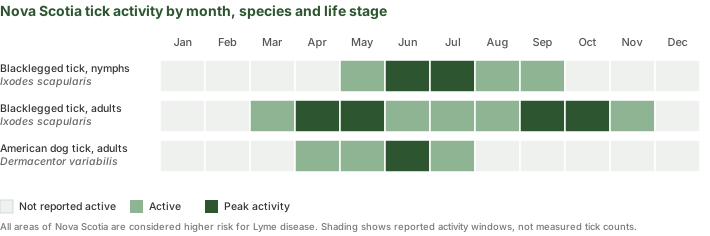
Adult blacklegged ticks are most active in spring and autumn, larvae and nymphs in spring and summer, and the whole population keeps questing until temperatures sit consistently below 4 °C. In a maritime climate that means a season running from roughly March into November, with the highest-consequence window in June and July when nymphs are out (Nova Scotia Department of Health and Wellness).
The province's own framing is worth quoting because it removes the guesswork: blacklegged ticks are found throughout Nova Scotia and all areas of the province are considered higher risk of Lyme disease. There is no low-risk corner to retreat to, and no month between the thaw and the freeze when a tick check is wasted effort.
Nova Scotia has the highest Lyme incidence in Canada
Nova Scotia reported 2,350 Lyme disease cases in 2024 at an incidence of 217 per 100,000 population — the highest rate of any province or territory, and 40% of Canada's national total of 5,809 cases from a province holding about 2.5% of the country's population. The province also held the top incidence spot the previous year, at 194.7 per 100,000 on 2,057 cases (Public Health Agency of Canada, Tick-borne disease surveillance in Canada).
Put beside its neighbours the contrast is stark. New Brunswick reported 111 cases in 2024 and Prince Edward Island 4. Nova Scotia's numbers are closer to Connecticut's than to the rest of Atlantic Canada's.
Four tick-borne infections are on the provincial radar, and their status differs:
- Lyme disease — considered established in Nova Scotia, meaning it is not expected to go away.
- Anaplasmosis (human granulocytic anaplasmosis) — rates are increasing.
- Babesiosis — sporadic cases reported.
- Powassan virus — the blacklegged tick here is known to spread it, but no human cases have been identified in the province.
What counts as a bad area for ticks in Nova Scotia
This is the question Nova Scotians most want a map for, and the honest answer is that the province has decided the map is not the useful unit. Nova Scotia publishes a county-level estimated risk areas map built from historical case data plus active and passive tick surveillance, but pairs it with the statement that all areas of the province are higher risk. When pharmacists were first enabled to prescribe Lyme prophylaxis in 2021, the regulator's own summary was that nearly all counties in Nova Scotia were by then considered high or moderate risk (Nova Scotia College of Pharmacists).
Habitat is the better predictor, and here the province is specific. Blacklegged ticks in Nova Scotia are found in long grass, leaf litter, shrubs, woody areas, urban parks and gardens. That last pair matters: this is not a wilderness problem. A Halifax back garden with a shaded, leafy border is habitat, and the province lists urban parks alongside forest.
One independent signal on geography is worth noting. The six-province study of American dog tick submissions found a statistically significant cluster of frequent submissions in Nova Scotia, with a relative risk of 2.53 compared with other areas (p = 0.038), concentrated in central and western Nova Scotia. That is the dog tick rather than the blacklegged tick, but it indicates where tick encounters generally are most frequent.
For your own address, use the county risk map on the provincial Lyme disease page, and see where specimens have actually been submitted from on the eTick public map.
Which ticks bite people here
| Species | Common name | Active months | Pathogens in Nova Scotia | Where you meet it |
|---|---|---|---|---|
| Ixodes scapularis | Blacklegged tick, deer tick | Adults spring and autumn; larvae and nymphs spring and summer; active above 4 °C | Borrelia burgdorferi (Lyme), Anaplasma phagocytophilum, Babesia spp., Powassan virus | Long grass, leaf litter, shrubs, woody areas, urban parks and gardens, province-wide |
| Dermacentor variabilis | American dog tick | Mid-April to late July, peak mid-June | Not a vector of the province's four blacklegged tick infections | Open grassy ground and trail edges; submissions cluster in central and western Nova Scotia |
Nova Scotia's dog tick season has been studied here for nearly fifty years — a 1978 study of D. variabilis population dynamics in southwestern Nova Scotia remains one of the earliest detailed Canadian datasets on the species. Its modern counterpart puts the provincial submission peak in mid-June, roughly two to three weeks later than the Manitoba peak.
A Nova Scotian can get prophylaxis at a pharmacy
This is the single most useful thing to know about tick bites in Nova Scotia, and it does not apply in most of Canada. Nova Scotia pharmacists can assess a tick bite and prescribe antibiotic prophylaxis for Lyme disease prevention, a role the Nova Scotia College of Pharmacists enabled in 2021 specifically to keep people out of emergency departments and walk-in clinics. Since May 2024, pharmacists can also assess and prescribe treatment for early Lyme disease.
The eligibility criteria for prophylaxis are narrow and time-bound:
- The tick is identified as a blacklegged tick.
- It was removed within the previous 72 hours.
- It had been attached for at least 36 hours.
For early Lyme treatment, eligibility covers people presenting with a localised erythema migrans rash larger than 5 cm who do not require confirmatory laboratory testing and show no signs of early disseminated or late disease. Both services are publicly funded with a valid Nova Scotia health card, and both need an in-person visual assessment — this cannot be done over the phone. The service does not include removing the tick, so take it out yourself first, keep it in a sealed bag, and photograph it before you go (Nova Scotia Pharmacare, healthcare services available from pharmacists).
The 72-hour window is the part people miss. If you find an engorged blacklegged tick on a Friday, the pharmacy route closes on Monday. Nova Scotia Health also runs a dedicated Tick Service, and there is a provincial tick line on 902-266-7199 or 1-866-266-7199 alongside 811.
Questions Nova Scotians ask
After a bite in Nova Scotia
- Remove the tick promptly with fine-tipped tweezers, pulling straight out. Our tick removal guide covers the technique.
- Keep the tick in a sealed bag and photograph it. Both the pharmacy assessment and eTick identification depend on this.
- Note the removal time, not just the date. The pharmacy pathway runs on a 72-hour clock from removal.
- If the tick was a blacklegged tick attached 36 hours or more, go to a pharmacy or call 811 promptly rather than waiting for symptoms.
- Either way, watch for a spreading rash or flu-like illness over the following weeks — what tick-borne illness looks like in people covers the timelines.
Given the province's incidence, prevention pays for itself faster here than almost anywhere in Canada. Our practical prevention checklist covers permethrin-treated clothing and the routine for coming indoors; the full tick prevention guide handles repellents and yard changes.
Cite this section
All About Ticks. Tick Season and Risk Areas in Nova Scotia. Updated 2026-08-30. Based on Nova Scotia Department of Health and Wellness guidance, Nova Scotia Pharmacare service scope, and Public Health Agency of Canada surveillance data for 2024.
Official Nova Scotia resources
- Nova Scotia — Lyme disease, including the county-level estimated risk areas map
- Nova Scotia Pharmacare — healthcare services available from pharmacists
- Nova Scotia Health — Tick Service
- 811 Nova Scotia — Tick-borne diseases
- eTick.ca — free photo-based tick identification
- Public Health Agency of Canada — Tick-borne disease surveillance annual report