Written by Phillip George · Last updated: September 9, 2026
When is tick season in Massachusetts?
Massachusetts has no reliably tick-free month. Blacklegged tick nymphs peak in June and July, which is when most human infections are acquired. Adults are active in spring and again in autumn, and will quest on any winter day when temperatures rise above freezing. American dog ticks appear in spring and early summer. If you are looking for a single window to be most careful, it is early summer, when the poppy-seed-sized nymphs are out.
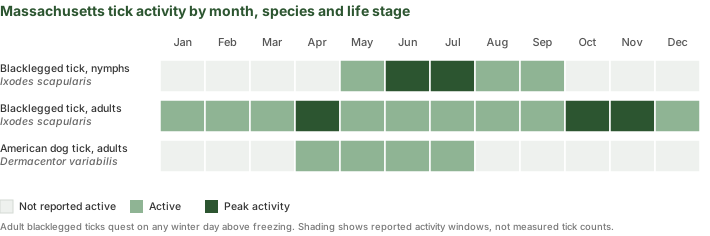
The Massachusetts tick calendar, month by month
- January to March: adult blacklegged ticks quest on thaw days. Winter bites happen; they are just uncommon.
- April: adult blacklegged ticks peak in spring. American dog ticks start appearing. Nymphs have not yet taken over.
- May: nymphs become active. Risk is rising but has not yet peaked.
- June and July: nymphal peak. This is the stretch behind most Lyme, babesiosis and anaplasmosis cases.
- August and September: nymph numbers fall. Case reports stay high because diagnosis lags exposure by weeks.
- October and November: adult season returns. These ticks are easier to see, so more of them get found and reported.
Which ticks bite people in Massachusetts
Most people here say deer tick, not Ixodes scapularis. The two names mean the same animal. The American dog tick is the wood tick of fields and trail edges. Lone star ticks are expanding on the Cape and islands.
| Species | Local name | Active months | Pathogens associated in MA | Where you meet it |
|---|---|---|---|---|
| Ixodes scapularis Blacklegged tick |
Deer tick | Nymphs May to September, peak June and July; adults spring and autumn, plus winter thaws | Lyme disease, anaplasmosis, babesiosis, hard tick relapsing fever, Powassan virus | Statewide; densest on Cape Cod, Martha's Vineyard and Nantucket |
| Dermacentor variabilis American dog tick |
Wood tick | April through July | Spotted fever group rickettsiae; tularemia is also reported in Massachusetts | Grassy and open ground, trail edges, pasture |
| Amblyomma americanum Lone star tick |
Lone star | Spring through summer | Ehrlichia species; associated with alpha-gal syndrome | Expanding on the Cape and islands |
How many cases Massachusetts reports
CDC national surveillance recorded 9,715 Lyme disease cases in Massachusetts in 2023 (CDC Lyme disease surveillance data; NNDSS annual tables, 2023). The Massachusetts Department of Public Health tabulated 9,728 Lyme disease reports for the same year. Small differences like that are normal: states and CDC close their annual files on different dates (Mass.gov tick-borne disease surveillance summaries).
Lyme is not the whole Massachusetts picture. For 2023, DPH also tabulated 837 babesiosis cases, 747 anaplasmosis cases, 47 Borrelia miyamotoi reports and 11 Powassan virus reports. Those numbers sit on the same surveillance page. Babesiosis was first recognized as a human disease on Nantucket, which is why older literature still calls it Nantucket fever. Cape Cod, Martha's Vineyard and Nantucket remain the parts of the state where people most often ask about babesiosis and anaplasmosis alongside Lyme.
Massachusetts is a high-incidence jurisdiction. Under the 2022 national case definition, high-incidence states count laboratory reports as probable cases without a case-by-case clinical investigation, so year-to-year jumps partly reflect counting rules. CDC separately estimates that about 476,000 people in the United States are diagnosed and treated for Lyme disease each year, far above the surveillance total (CDC Lyme disease surveillance and data).
Cape Cod, the Vineyard and Nantucket
Risk is high across most of the mainland, but the Cape and islands are where many visitors ask, and for good reason. Blacklegged ticks are dense in dune-edge shrub, oak woods and the brush along bike paths. Lone star ticks are expanding in the same coastal strip. Dune grass, wooded trail edges and the boundary between a mown lawn and the trees are the highest-exposure spots. The habitats guide explains why that edge is riskier than the middle of a sunny lawn, and yard-level tick control covers what the evidence actually shows.
Tick testing in Massachusetts
The Massachusetts Department of Public Health does not offer tick identification or testing. It lists commercial labs as a convenience, not an endorsement, and it is blunt about what a tick test can and cannot tell you: a positive or negative result on a tick is not evidence that you were or were not infected, the tick you found may not be the one that bit you, and you should not wait for results before seeing a clinician if you feel sick (Mass.gov — Tick identification and testing services).
TickReport, based at 29 Cottage Street in Amherst, identifies ticks and tests them for pathogens for a fee, with results in about three business days after the tick arrives. Massachusetts residents can hand-deliver a tick to the laboratory. Mass.gov listed TickReport fees in the $50 to $200 range as of June 2021; current prices are on the lab's own site. TickReport compares the result to a carbon monoxide detector: it tells you a hazard was present, not what happened to you.
Found a tick in Massachusetts? Do this
- Remove it promptly with fine-tipped tweezers. Follow the tick removal guide. Save the tick in a bag or container.
- Decide whether to test it. If you do, mail or hand-deliver it to TickReport. Do not wait for results if you already feel ill.
- Record the date and location and watch for a rash or flu-like symptoms for several weeks. Babesiosis and anaplasmosis matter here, not only Lyme.
- Contact a healthcare provider if symptoms develop. A tick test is useful context, not a diagnosis.
Cite this section
All About Ticks. Ticks in Massachusetts. Updated 2026-09-09. Based on Massachusetts DPH tick-borne disease surveillance summaries, Mass.gov tick identification and testing guidance, TickReport, and CDC Lyme surveillance tables for 2023.
Official Massachusetts resources
- Mass.gov — Tick-borne diseases
- Mass.gov — Tick-borne disease surveillance summaries and data
- Mass.gov — Tick identification and testing services
- TickReport — mail-in tick testing
- CDC — What to do after a tick bite
Common questions
Where to go from here
If a tick is attached, start with the removal guide. Neighbouring states: New York and New Jersey.