Written by Phillip George · Last updated: August 30, 2026
Where do ticks live?
Ticks live wherever three things overlap: air humid enough that they do not dry out, low vegetation they can climb, and animals that walk past it. On a typical property in eastern North America, that combination is concentrated in a strip a few metres wide where the woodland meets the lawn. Almost everything else about tick habitat follows from those three requirements.
Humidity is the constraint everything else bends around
A tick spends the overwhelming majority of its life not feeding. Between blood meals it has no way to drink, so it survives by absorbing water vapour out of the air. That only works above a threshold. Laboratory and field work on blacklegged tick (Ixodes scapularis) nymphs identified a critical equilibrium activity point around 82% relative humidity, below which the moisture deficit is too large for a nymph to extract water from the air. Rhode Island researchers used that figure to define an "adverse moisture event" as more than eight continuous hours below 82% relative humidity in the leaf litter, and found the number of those events predicted the following season's nymphal abundance across a 14-year surveillance record (Berger et al., Parasites & Vectors, 2014).
This is why leaf litter and the duff layer beneath it matter far more than any other single habitat feature. The litter is not decoration; it is the tick's humidity reservoir. Field observations show questing nymphs periodically descend into the lower leaf litter to rehydrate during the drier, warmer parts of the day, and that they can recover from short spells of dry air but not from sustained ones (Berger et al., Journal of Medical Entomology, 2014). A tick's day is therefore a negotiation between hunting and hydrating, and the depth and dampness of the litter set the terms.
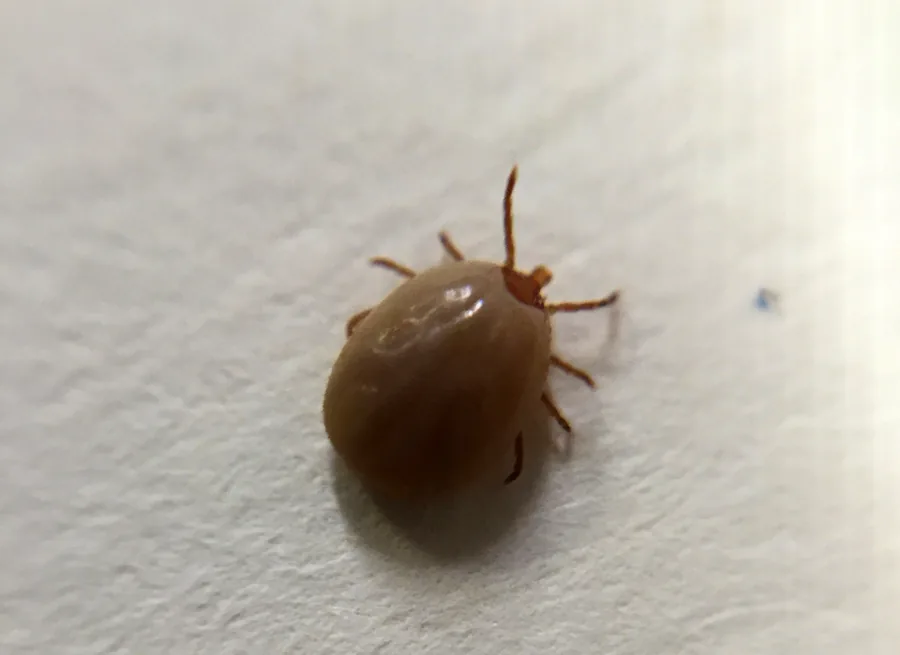
Engorged deer tick - ticks are commonly found in forested areas with dense vegetation and leaf litter. Image: Wikimedia Commons (NIAID, CC BY 2.0)
It also explains habitats that seem inconsistent at first glance. Deciduous leaf litter holds moisture better than the thin, acidic litter under conifers, which is one reason deciduous and mixed stands generally hold more blacklegged ticks than pure coniferous ones. Dense infestations of invasive shrubs such as Japanese barberry raise humidity at ground level and are positively correlated with higher nymph densities (Linske et al., Environmental Entomology, 2024). A mown, sunlit lawn fails the humidity test for most of a summer afternoon, which is the real reason so few ticks are found on one.
Questing: sit-and-wait, or go looking
Questing is the host-seeking posture — a tick anchored by its rear legs with its forelegs outstretched, sensing carbon dioxide, heat and odour through the Haller's organ on its front tarsi. What differs between species is how far the tick is willing to travel to use it.
Ixodes ticks are close to pure ambushers. They climb, wait, and will crawl toward a stationary host only over very short distances, on the order of half a metre. Amblyomma ticks sit at the other end of the spectrum. Lone star ticks (Amblyomma americanum) prefer walking on the ground to climbing, actively track host cues, and have been recorded moving 5 to 12 metres in 24 hours and up to 23 metres over 72 hours (Fischer et al., Parasites & Vectors, 2025). Standing still is a reasonable defence against a blacklegged tick and a poor one against a lone star tick. It is also why drag-cloth surveys, which sample vegetation, undercount active hunters that are not on the vegetation in the first place.
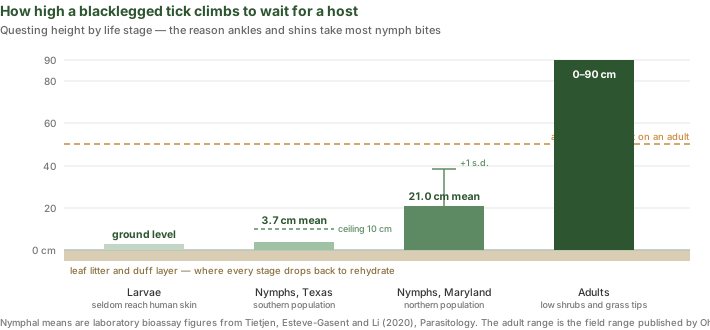
Life stage changes the height, and height changes who gets bitten. Larvae stay in and just above the litter and seldom reach human skin. Nymphs climb, but not far: a bioassay comparing populations found Maryland nymphs quested at a mean of 21.0 cm while Texas nymphs averaged 3.7 cm and never exceeded 10 cm, a difference the authors link to the southern population's greater reliance on lizards as hosts and one that may help explain the geographic pattern of Lyme disease risk (Tietjen et al., 2020). Adults climb highest of all, questing on the tips of low shrubs at roughly knee height because their target is a deer, and Ohio State University Extension gives the working range as ground level to about three feet. Nothing in that range involves jumping, flying or dropping from trees.
Hosts: the mice make the risk, the deer make the ticks
A blacklegged tick feeds three times in a life cycle that usually runs two years, and each stage tends to take a different kind of host. Larvae and nymphs feed mainly on small mammals and birds; adults feed mainly on deer. Those two roles are completely different in what they contribute.
The white-footed mouse (Peromyscus leucopus) is the pathogen engine. It is the most competent known reservoir for the Lyme bacterium in eastern North America, infecting between 40% and 90% of the larval ticks that feed on it, and it tolerates degraded and fragmented habitat well (LoGiudice, Ostfeld, Schmidt and Keesing, PNAS, 2003). That paper also set out the dilution effect: most other hosts are poor reservoirs, so they feed ticks without infecting them. Squirrels act as "dilution hosts" — high tick burdens, low reservoir competence, high density — while shrews act as "rescue hosts" that keep infection prevalence up when mouse numbers fall. Add host species to a depauperate community and the share of nymphs carrying the pathogen goes down.
White-tailed deer play the opposite role. They are poor reservoirs for the Lyme bacterium, so a tick that feeds on a deer is unlikely to pick the infection up there. What deer provide is reproduction. Adult ticks mate on them, and an engorged female drops into the leaf litter to lay a single egg mass of roughly 1,500 to 2,000 eggs (University of Rhode Island TickEncounter). Blacklegged tick distribution tracks deer distribution closely for that reason. The practical consequence is that deer determine how many ticks a landscape can carry, while the small-mammal community determines what proportion of them are infectious — and a yard-management plan aimed at one of those does not automatically address the other.
The edge effect: why the lawn boundary is the riskiest strip you own
An ecotone is the transition zone between two habitats. For ticks, the ecotone between woodland and lawn is not a midpoint between two risk levels — it is the peak. The classic measurement comes from 67 residences in Armonk, Westchester County, New York, where 1,790 ticks were collected and sorted by habitat: 67.3% came from woods, 21.6% from the unmaintained edge, 9.1% from ornamental vegetation and 2.0% from lawns. Larvae concentrated in the woods, while nymphs and adults were dispersed across all four habitat types, and tick abundance rose with property size because larger properties were more likely to contain a woodlot (Maupin, Fish, Zultowsky, Campos and Piesman, American Journal of Epidemiology, 1991).
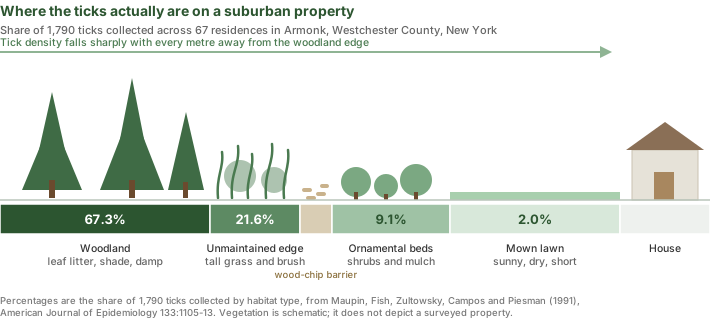
Later work has tightened the estimate rather than overturned it. A 2024 study of 42 residential properties in Guilford, Connecticut proceeds from the established finding that blacklegged ticks are most abundant in the one-metre forested ecotone surrounding the lawn edge, and examined which habitat features within it drive density (Linske et al., 2024). A CDC study in Washington County, Minnesota found the same pattern in the north-central US: on residential properties, nymphal densities were highest in the ecotone between forest edge and lawn, and the residences with the highest densities were more likely to have a high percentage of forest cover, log piles and signs of deer (Johnson et al., CDC Stacks). That study also found high nymph densities on mowed recreational trails, not only in the woods beside them.
The edge concentrates every requirement at once. Litter and shade hold humidity above the threshold, dense low growth gives questing structure at the right height, and mice, chipmunks and deer all move along the boundary rather than across open ground. It is also, on most properties, exactly where the swing set, the woodpile and the shortcut to the compost heap are. Our guide to reducing tick numbers on a property covers what can be done about that strip specifically.
Land use, fragmentation and moving range boundaries
Breaking forest into small pieces does not simply reduce tick habitat proportionally; it changes the animal community inside what remains. Sampling 14 maple-dominated forest patches between 0.7 and 7.6 hectares in Dutchess County, New York found a significant linear decline in nymphal infection prevalence as patch area increased, and a significant exponential decline in nymphal density. The combined effect was a sharp rise in the density of infected nymphs — the standard measure of human Lyme disease risk — as patches got smaller (Allan, Keesing and Ostfeld, Conservation Biology, 2003). Small remnant woodlots lose the predators and the host diversity that keep white-footed mouse numbers down, and the dilution effect goes with them. A postage-stamp woodlot behind a subdivision can carry higher risk per square metre than a large intact forest.
Range boundaries are moving as well. An empirical model built on Canadian tick submissions from 1990 onward projected the blacklegged tick range front advancing north at roughly 46 km per year, with the rate varying between 35 and 55 km per year depending on accumulated degree days above 0 °C. Temperature was the single most important determinant of whether a population could establish, and both long-distance dispersal by migratory birds and local dispersal by resident hosts mattered to how fast the front moved (Leighton, Koffi, Pelcat, Lindsay and Ogden, Journal of Applied Ecology, 2012). Public Health Agency of Canada surveillance has continued to document both species range and pathogen prevalence expanding across central and eastern Canada (Canada Communicable Disease Report, 2026). Habitat that was climatically unsuitable a generation ago is now suitable, which is why "there are no ticks here" ages badly as local knowledge.
Seasonal habitat use, and where ticks are in winter
Ticks do not leave the habitat in winter; they move down within it. Adults and overwintering immatures shelter under leaf litter and in soil pores, where the litter and any accumulated snow insulate them and hold ground-level conditions much closer to freezing than the air above. Researchers who have monitored blacklegged ticks at the same sites for more than 30 years report finding no relationship between how cold a winter was and how abundant nymphs were afterwards, and note that ticks placed in soil cores where they can burrow survive winter far better than ticks held on the surface (Cary Institute of Ecosystem Studies). A single hard freeze does not reset a property's tick population.
Dormancy is also conditional rather than absolute. Adult blacklegged ticks are active from October through May as long as daytime temperature stays above freezing (University of Rhode Island TickEncounter), and the Province of Manitoba places blacklegged tick exposure across April to November, with questing continuing until the first permanent snowfall or once air temperatures sit consistently below about 4 °C (Province of Manitoba). A February thaw brings adults back to the tips of the shrubs. The same vertical movement happens on a daily cycle in midsummer, when ticks retreat into the litter during the driest hours and quest again as humidity recovers — so the same patch of ground can be a hazard at eight in the morning and nearly empty of questing ticks at two in the afternoon.
Habitat by habitat
Deciduous and mixed forest
The core habitat for blacklegged ticks. Deep, damp leaf litter, closed canopy, and a full small-mammal community. Trailside vegetation is the part you actually contact.
Grassland, prairie and old field
Favoured by Dermacentor wood ticks, which tolerate more open and drier conditions than Ixodes. Unmown field edges and fencelines hold the most.
Suburban yards and parks
Risk is concentrated at the woodland boundary, in ornamental beds with deep mulch, around log piles and in any unmown corner, rather than spread evenly across the property.
Coastal scrub and island habitat
Maritime shrub and coastal woodland hold humidity well and often carry dense deer populations with no predators, a combination that supports very high tick densities.
Indoors
The brown dog tick is the exception to everything above. It completes its whole cycle around homes and kennels, so an indoor infestation is possible with that species and effectively not with the others.
Where ticks are scarce
Short mown turf in full sun, gravel, paving, and dry open ground away from an edge. The centre of a wide trail is genuinely lower risk than its verges.
What this means for a property
The ecology points at a small number of high-yield changes rather than a general tidy-up. Leaf litter removal significantly reduces nymph abundance because it lowers ground-level humidity and raises desiccation risk, while increasing litter depth increases tick density — the mechanism is water, not tidiness (Linske et al., 2024). A dry barrier of wood chips or gravel along the woodland boundary works for the same reason. Moving play equipment, seating and woodpiles away from the edge takes people out of the strip that holds a fifth of the ticks and puts them in the strip that holds one in fifty. Managing invasive understorey shrubs removes questing structure and humid microhabitat together.
None of that makes a property tick-free, and habitat change is one layer among several. Pair it with the personal measures in our tick prevention guide, and learn what you are actually looking at with the tick identification guide.
FAQ
Cite this page
All About Ticks. Tick Habitats: Humidity, Leaf Litter and the Edge Effect. Last updated 30 August 2026.
Primary sources: Maupin et al. (1991), LoGiudice et al. (2003), Allan et al. (2003), Berger et al. (2014), Leighton et al. (2012)