Written by Phillip George · Last updated: August 30, 2026
When is tick season in British Columbia?
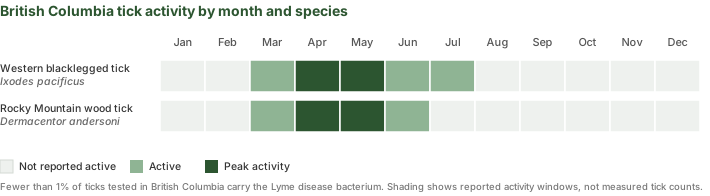
Both of the ticks that regularly bite people in British Columbia are spring ticks. The Rocky Mountain wood tick (Dermacentor andersoni) is most active from March to June, and the western blacklegged tick (Ixodes pacificus) is active mainly in spring and early summer (Province of British Columbia, Ticks in British Columbia). BC's tick season is earlier and shorter than Ontario's or Nova Scotia's, and the risk profile is genuinely different too.
BC has more than 20 tick species, but only three normally bite humans, and the province splits cleanly in two. Ixodes pacificus and Ixodes angustus predominate in the southern coastal regions; Dermacentor andersoni is more common in the Interior and the north (BC CDC, BC Medical Journal, 2024).
Lyme disease risk in BC is genuinely low, and the numbers say so
This is where BC differs most sharply from eastern Canada, and the BCCDC quantifies it rather than hedging. In British Columbia, fewer than 1% of ticks tested carry Borrelia burgdorferi, and the prevalence has stayed consistently low even as submission volumes rose. Between 2013 and 2022 the province recorded 6 to 39 Lyme disease cases per year in total, most of them travel-related; locally acquired cases run between 1 and 14 a year (BCCDC, Lyme disease). BC reported 21 cases in 2024, an incidence of 0.37 per 100,000, against Nova Scotia's 217.
The BCCDC's risk map states the comparison directly: BC runs below 0.5 cases per 100,000 population with a 0.2% tick infection rate, against roughly 29 cases per 100,000 and a 40% tick infection rate in the highly endemic northeastern United States. Two reasons underlie the gap. The tick species differ — I. pacificus and I. angustus are less efficient at transmitting B. burgdorferi than the eastern I. scapularis. And the forests differ: BC's coastal conifer rainforest is poorer tick habitat than the leafy deciduous woodland of eastern Canada.
Low is not zero, and the province's own advice is still to remove ticks promptly and watch for symptoms. But it is reasonable for a British Columbian to worry less about Lyme disease than a Nova Scotian, and unreasonable to apply eastern Canadian anxiety to a Kamloops hillside.
Tick paralysis is BC's distinctive concern
In the Interior, the thing worth knowing about is not Lyme disease. Dermacentor andersoni is the leading cause of human tick paralysis in Canada — a reversible weakness caused by a toxin in the tick's saliva, which resolves once the tick is fully removed. It usually follows several days of attachment.
It is rare. The disease is not reportable and official counts do not exist, but the BCCDC Public Health Laboratory takes consultations on 0 to 2 human cases per year in the province. Most occur in the Interior in spring and summer, and children are affected more often than adults (BCCDC, Tick paralysis). The practical consequence is that in BC, complete and prompt removal matters for a reason that has nothing to do with bacteria.
Annual counts for the other BC tick-borne infections are similarly small: tularemia 0 to 2 cases, Rocky Mountain spotted fever 0 to 3, tick-borne relapsing fever 0 to 7, and no reported cases of anaplasmosis or babesiosis.
Where BC's ticks actually are
The province publishes specific geography for the western blacklegged tick, and it is more useful than "coastal BC". Ixodes pacificus is common on Vancouver Island and the Gulf Islands, on the coastal mainland from the U.S. border north to Powell River, and along the Fraser River as far inland as Yale and Boston Bar. It lives on low plants in forests, along trails, and in brushy areas. The BCCDC adds the Sunshine Coast, Greater Vancouver and the Fraser Valley to the list of places Ixodes ticks are most commonly found.
The Rocky Mountain wood tick lives mainly in the dry Interior east of the Coast Mountains, from the U.S. border north toward Williams Lake and on into Alberta, and is common in open, grassy and rocky ground. Both species wait on grass and shrubs for a host to brush past rather than dropping from trees.
Instead of reproducing a map, use the province's own: the BCCDC Lyme risk areas map lets you type in any BC address and see whether it falls in a risk area. It is built by ecological niche modelling from field sampling, clinical submissions and ten environmental predictor layers covering vegetation, temperature and precipitation, which makes it considerably more informative than a shaded provincial outline.
Vancouver, Vancouver Island and the Gulf Islands
Greater Vancouver and Vancouver Island are both inside the western blacklegged tick's range, so the answer to whether there are ticks in Vancouver is yes. The Island is listed first among the places I. pacificus is common, and the BCCDC's map shows risk areas across much of it rather than in isolated pockets.
What that means in practice is narrower than it sounds. The risk of Lyme disease from a bite remains low, because the provincial tick infection rate is around 0.2%. An Island or North Shore hiker in April or May is more likely to pick up a tick than a Winnipegger is, and much less likely to get Lyme disease from it than an Ontarian would be. The BCCDC also notes that because these ticks are already established in BC's most populous areas, further range expansion is unlikely to change disease prevalence much.
The sensible routine on the Island and the coast: check after walking brushy trails from March through July, remove anything attached completely and promptly, and photograph it for eTick rather than assuming what it was.
Which ticks bite people in British Columbia
| Species | Common name | Active months | Associated with | Where in BC |
|---|---|---|---|---|
| Ixodes pacificus | Western blacklegged tick | Mainly spring and early summer | Borrelia burgdorferi (Lyme disease), Anaplasma phagocytophilum, Babesia spp. — under 1% infection rate in BC | Vancouver Island, Gulf Islands, coastal mainland to Powell River, Fraser River to Yale and Boston Bar |
| Ixodes angustus | No standard common name | Not published by the province | The second BC species in which B. burgdorferi has been found | Southern coastal regions |
| Dermacentor andersoni | Rocky Mountain wood tick | Most active March to June | Tick paralysis, Rocky Mountain spotted fever, tularemia — all rare in BC | Dry Interior east of the Coast Mountains, U.S. border north toward Williams Lake |
Getting a BC tick identified
British Columbia participates in eTick, so you can photograph a tick and receive a species identification at no cost, usually within a couple of days. Given how differently the two main BC species behave — one a low-probability Lyme vector, the other a paralysis risk — knowing which one bit you changes what to watch for.
The BCCDC also publishes an annual tick surveillance and Lyme disease report, which is the place to look for current infection rates rather than relying on a figure quoted second-hand. One clinical detail from the province's own guidance for physicians is worth carrying: a localised rash appearing within the first 48 hours of a tick bite is more likely a local reaction to the bite than an infection.
Common questions about BC ticks
After a bite in British Columbia
- Remove the tick promptly and completely with forceps or fine-tipped tweezers. Complete removal matters here because of tick paralysis, not just infection. See our tick removal guide.
- Photograph it and submit to eTick. The coastal and Interior species carry entirely different concerns.
- Note the date and place, and watch for fever, rash, fatigue or aches. A rash within the first 48 hours is more likely a local reaction than an infection.
- Watch specifically for unexplained weakness or difficulty swallowing or speaking after a prolonged attachment in the Interior, and seek care promptly if it appears.
- Call HealthLink BC on 811 or your own provider with questions about a specific bite.
Because BC's season is compressed into spring, prevention effort concentrates well. Our practical prevention checklist covers permethrin-treated clothing and what to do on coming indoors; the full tick prevention guide covers repellents in more depth. See what tick-borne illness looks like in people for symptom timelines.
Cite this section
All About Ticks. Tick Season in British Columbia. Updated 2026-08-30. Based on BC Centre for Disease Control tick-borne disease resources, Province of British Columbia tick guidance, and Public Health Agency of Canada surveillance data for 2024.
Official BC resources
- BCCDC — Lyme risk areas map, searchable by address
- BCCDC — Lyme disease, including the annual tick surveillance report
- BCCDC — Tick paralysis
- Province of British Columbia — Ticks in British Columbia
- eTick.ca — free photo-based tick identification
- Public Health Agency of Canada — Tick-borne disease surveillance annual report