Identifying Different Tick Species
Being able to identify different tick species helps you understand your risk for specific diseases. Different ticks carry different diseases, and they're found in different parts of the country. Here's a simple guide to help you identify the most common ticks you might encounter.
Black-Legged Tick (Deer Tick)
Ixodes scapularis - Also called the deer tick

Black-legged tick (Ixodes scapularis) showing characteristic black legs. Image: Wikimedia Commons (USDA, Public Domain)
Key Features:
- Size: Small - about 3-5mm (size of a sesame seed) when unfed
- Color: Reddish-brown to dark brown body with black legs (this is the key identifier!)
- Markings: No white markings on the back
- Where found: Northeastern and upper midwestern United States, parts of Canada
Diseases It Can Spread:
- Lyme disease
- Anaplasmosis
- Babesiosis
- Powassan virus
Reference: CDC - DPDx - Ticks | Eisen, R.J., & Eisen, L. (2018). The Blacklegged Tick, Ixodes scapularis: An Increasing Public Health Concern. Trends in Parasitology, 34(4), 295-309.
American Dog Tick
Dermacentor variabilis
Key Features:
- Size: Larger than deer tick - 5-15mm when unfed
- Color: Brown with white or gray markings on the back
- Markings: Distinctive white/gray patterns, especially on females
- Where found: Throughout the eastern United States and parts of the west coast
Diseases It Can Spread:
- Rocky Mountain spotted fever
- Tularemia

American dog tick (Dermacentor variabilis) showing white/gray markings. Image: CDC PHIL (Public Domain)
Reference: CDC - DPDx - Ticks | James, A.M., et al. (2015). The geographic distribution and ecological preferences of the American dog tick. Medical and Veterinary Entomology, 29(2), 178-188.
Lone Star Tick
Amblyomma americanum
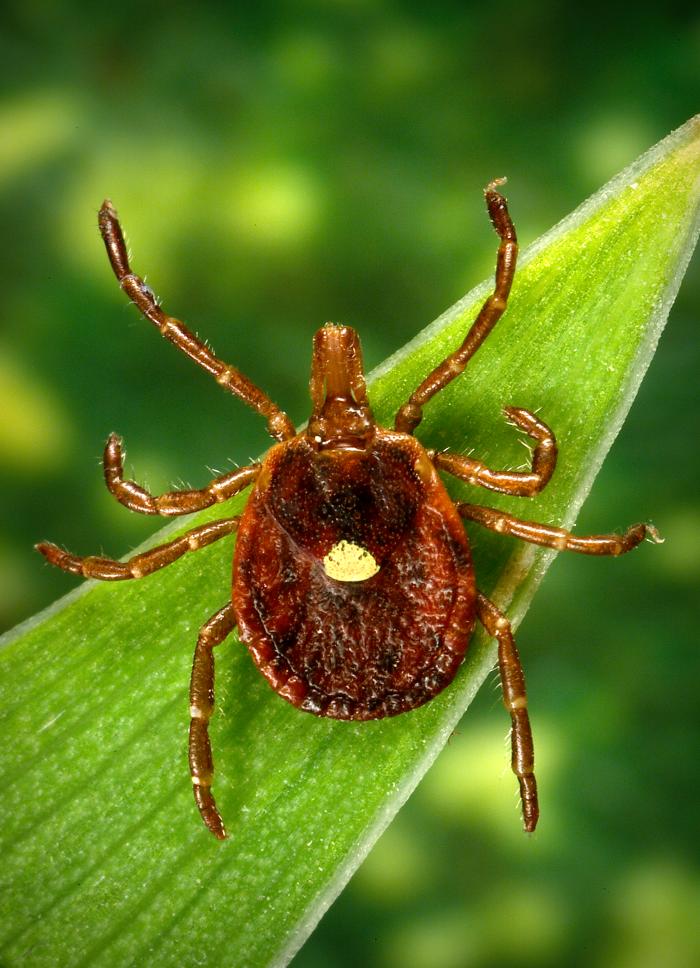
Lone star tick (Amblyomma americanum) - note the distinctive white spot on the female's back. Image: CDC PHIL (Public Domain)
Key Features:
- Size: Medium - 5-7mm when unfed
- Color: Reddish-brown
- Markings: Adult females have a distinctive white spot or "lone star" on their back - this is the easiest way to identify them!
- Where found: Southeastern and eastern United States (expanding north and west)
Diseases It Can Spread:
- Ehrlichiosis
- Tularemia
- STARI (Southern tick-associated rash illness)
- Alpha-gal syndrome (red meat allergy)
Reference: Holderman, C.J., & Kaufman, P.E. (2021). Lone Star Tick Amblyomma americanum. University of Florida IFAS Extension.
Brown Dog Tick
Rhipicephalus sanguineus
Key Features:
- Size: Small to medium - 3-5mm when unfed
- Color: Uniform reddish-brown (no distinctive markings)
- Markings: None - just plain brown
- Where found: Worldwide, especially in warmer climates. Can survive indoors!
- Unique: This is the only tick that can complete its entire life cycle indoors
Diseases It Can Spread:
- Rocky Mountain spotted fever (in southwestern U.S. and Mexico)

Brown dog tick (Rhipicephalus sanguineus) - uniform reddish-brown color with no distinctive markings. Image: CDC PHIL (Public Domain)
Reference: CDC - DPDx - Ticks | Dantas-Torres, F. (2010). Biology and ecology of the brown dog tick. Parasites & Vectors, 3, 26.
Western Blacklegged Tick
Ixodes pacificus - Similar to the black-legged tick but found on the West Coast
- Where found: Pacific Coast states (California, Oregon, Washington, Nevada, Utah, Arizona)
- Diseases: Lyme disease, anaplasmosis
- Looks like: Very similar to the eastern black-legged tick
Reference: Eisen, R.J., Eisen, L., & Beard, C.B. (2016). County-Scale Distribution of Ixodes scapularis and Ixodes pacificus. Journal of Medical Entomology, 53(2), 349-386.
Understanding Tick Life Stages
Ticks change size and appearance as they grow. Here's what to look for at each stage:
Larva (Baby Tick)
- Very tiny - about 1mm
- Has only 6 legs
- Often too small to see easily
- Usually doesn't transmit diseases
Nymph (Teenage Tick)
- Small - about 2mm (size of a poppy seed)
- Has 8 legs
- Very hard to spot!
- Can transmit diseases
Adult (Full Grown)
- Larger - 3-15mm depending on species
- Has 8 legs
- Easiest to see and identify
- Can transmit diseases
Reference: CDC - DPDx - Ticks
Quick Identification Guide
When you find a tick, look for these key features:
| Feature | What to Look For |
|---|---|
| Size | Note how big it is - this helps narrow down the species |
| Color | Overall color and any patterns or markings |
| Markings | White spots, stripes, or patterns on the back |
| Legs | Count the legs - adults have 8, larvae have 6 |
| Location | Where you found it (geographic area) helps identify species |
| Fed or Unfed | Engorged (fed) ticks are much larger and harder to identify |
Reference: CDC - DPDx - Ticks
Geographic Distribution Changes
Tick ranges are expanding! Here's what researchers have found:
Black-Legged Tick Expansion
- 1996: Found in 1,058 counties in 41 states
- 2015: Found in 1,420 counties (45.7% of U.S. counties)
- Trend: Continuing to expand into new areas
Why it matters: As ticks spread to new areas, more people are at risk for tick-borne diseases.
Reference: Eisen, R.J., Eisen, L., & Beard, C.B. (2016). County-Scale Distribution of Ixodes scapularis and Ixodes pacificus. Journal of Medical Entomology, 53(2), 349-386.
Need Help Identifying a Tick?
If you're not sure what type of tick you found:
- Take clear photos from different angles
- Note where you found it (state, county, type of area)
- Contact your local health department
- Use online tick identification services
- Consider tick testing services (though this doesn't replace medical care if you have symptoms)
Remember: Proper identification can help your doctor assess your risk for specific diseases, but always seek medical attention if you develop symptoms after a tick bite, regardless of the tick species.